Why public concern about climate change isn't enough
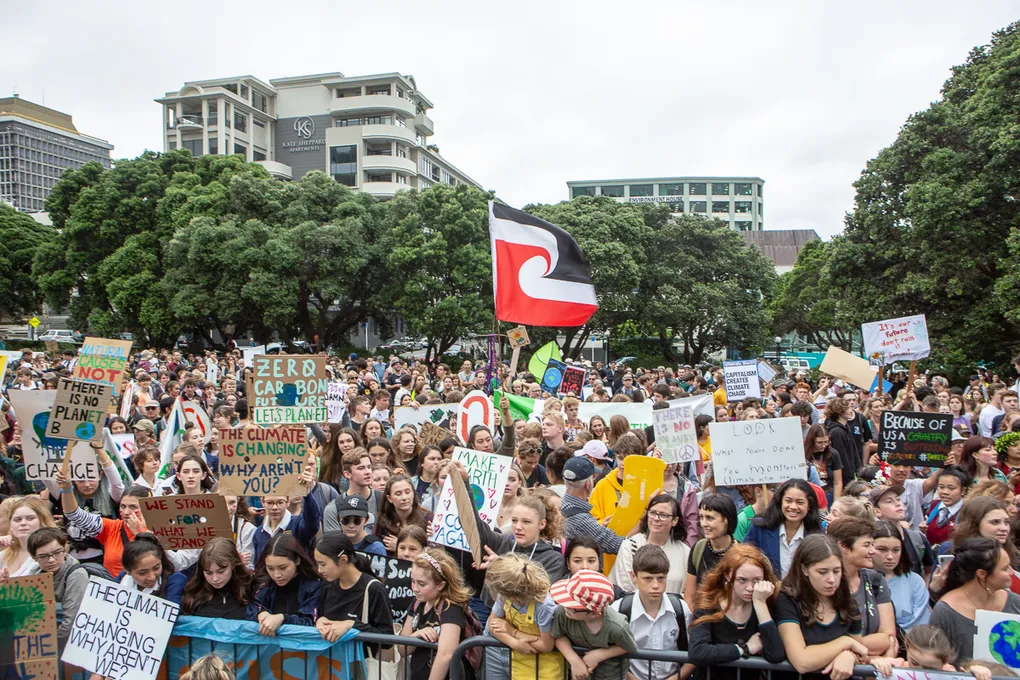
Why hasn’t the world done more to combat climate change? This is a question I’ve been thinking about for a decade (or more). The usual answer is that immensely powerful and rich corporations, and the billionaires who control them, benefit from the status quo, and so obstruct and block climate action.
While I don’t doubt that vested interests are responsible for slowing down climate action, I am not convinced that their influence is the whole story of the world’s response to climate change. I’ve spent years researching what the public thinks about climate change, because I believe it is an important part of the picture of climate inaction.
In my previous post, I wrote about why NZ is unlikely to have a climate election in 2026, focusing on how people rank climate change in importance against other issues (“issue importance”). Today, I’ll dig further into public opinion, and explain why public opinion on climate change really matters. I’m again using data from my survey of members of the public in New Zealand and Australia, and will also present some data from around the world to give you an idea of how we compare.
Climate denial & concern
When people think about climate opinion, often their first thought is climate denial: some people believe that climate change is simply not happening, or that it’s not a serious threat.
Data source: Crawley (2022)
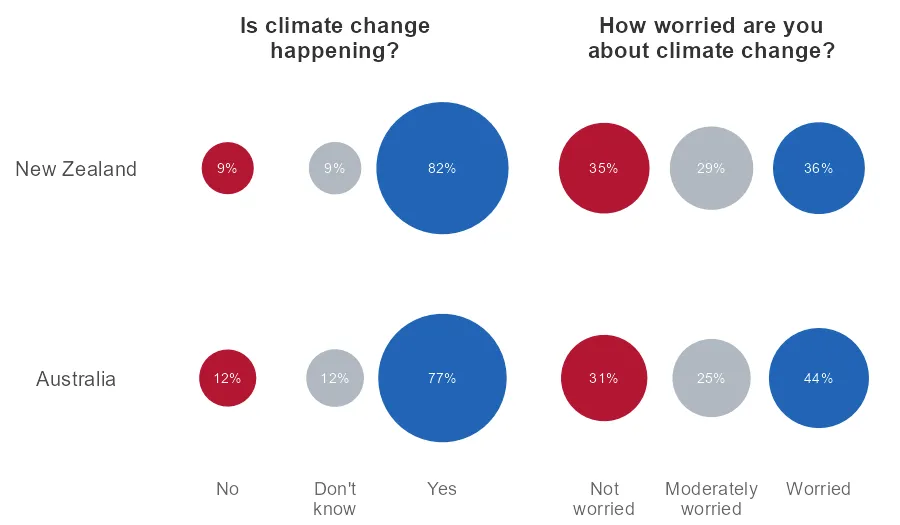
As we can see from this figure, though, only a small percentage of the population of New Zealand and Australia could be called climate deniers.1 This percentage of denial is fairly consistent around the world; data from Yale CCC shows that even in the US, only 14% of people say that climate change isn’t happening.
Public concern or worry about climate change is a bit lower than belief that climate change is happening. A majority of the public in both countries are at least moderately worried about climate change (although you could definitely argue that being “moderately” worried does not do justice to the scale of the threat). Yale CCC backs up these findings, showing that the majority of the public in almost every country are very or somewhat worried about climate change.2
If the public broadly accepts that climate change is happening, and are worried about it, does that suggest that what the public wants doesn’t influence climate policy?
Not necessarily. Concern about climate change does not automatically translate into votes for parties that prioritise addressing it. To get a more complete picture of climate opinion, we need to explore another part of it: issue importance.
Issue importance & climate change
As I showed previously, climate change is not an issue that usually features prominently in elections. To understand why, we need to investigate people’s issue rankings. People may be concerned about a lot of different issues, like the economy, cost of living, health care, climate change and so on. Usually though, only a handful of these issues will affect how a person votes in an election.
Last time, I showed you issue ranking data from New Zealand. Here’s the same data, but this time showing the results for Australia as well.
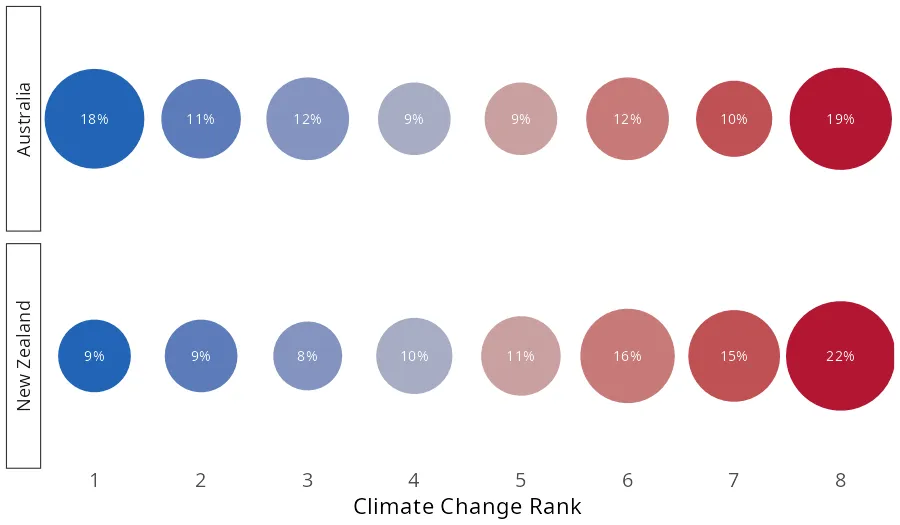
Other issues: Health Care, Education, Crime, Immigration, The Economy, Terrorism, Poverty.
Data source: Crawley (2022)
Interestingly, in 2022 when this survey was conducted, climate change was an important issue in Australia for many people, especially in comparison to New Zealand. This was just after the Federal Election that year, which many branded a “climate election”; my data backs up that assertion.
But how does climate salience in these two countries compare to the rest of the world?
Climate change importance around the world
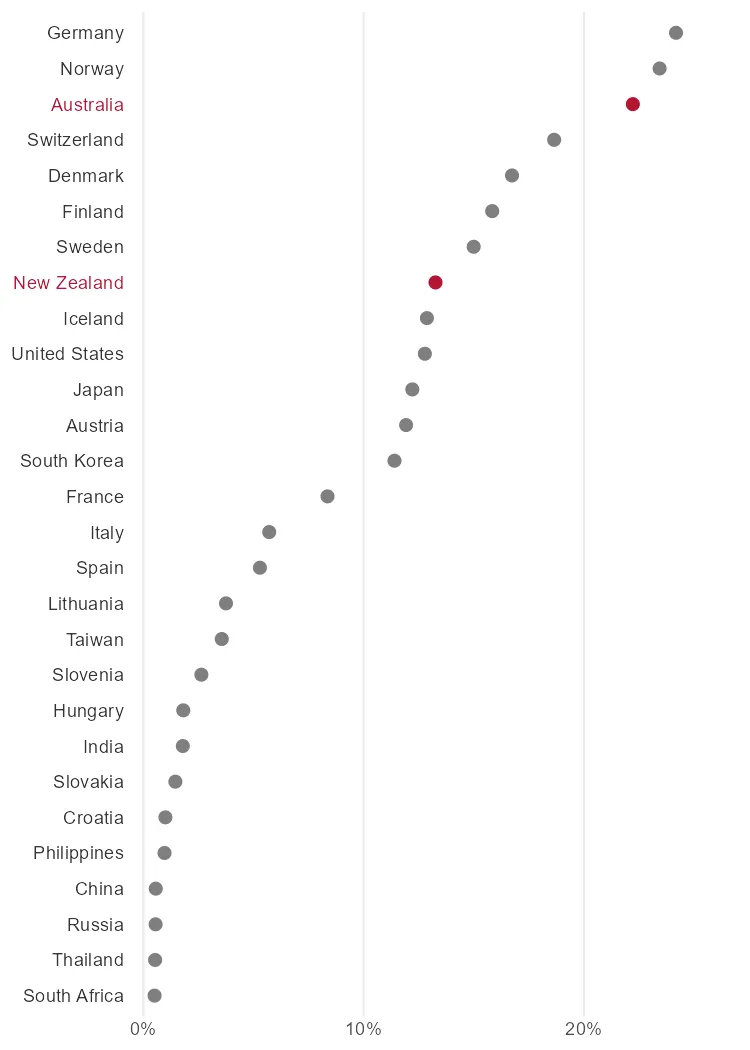
How does climate importance in New Zealand and Australia measure up to the rest of the world? While data on this topic is not easy to come by, here is some from the 2020 International Social Survey Programme, showing the percentage of people who see climate change as an important issue in countries around the world.3
Data source: ISSP (2020)
Australia is near the top, having one of the highest percentages of the population who see climate change as high importance, just behind Germany and Norway. These three countries are the only ones with more than 20% of the public ranking climate change as high importance. Only 13% of the NZ public rank climate change as high importance.
These rankings show us why climate change does not feature much in elections around the world: most people see other issues as more important.
The public and climate action
The gap between belief and issue importance has real consequences for climate policy and politics. In my view, low issue importance is part of the reason why the world has been slow to act on climate change. Climate change is an extremely complex issue, requiring significant costs and far-reaching social changes to resolve. Most politicians are only likely to take substantial action if they believe their jobs are on the line.4 Because most people are not voting with climate change in mind, politicians are not under much public pressure to act on climate change. They know they can still win re-election, even if they pay only lip service to climate action.
It’s important to note that I am not arguing that individuals are to blame for the world’s slow response to climate change. Corporate interests are still a major player. Besides which, I don’t blame people for having issues like the cost of living and health care — rather than climate change — at the front of their minds. These are issues that affect their everyday lives right now. Some people may have had their lives upended by climate change (or worse), but for most people climate change is something to worry about for the future.
What, then, can be done? The key to action is helping people see that climate change needs attention sooner rather than later. In my view, this requires much more than grabbing headlines with disruptive protests. It’s about changing what people prioritise when they vote. Admittedly, that’s no easy task, but is what the data suggests is required.
Footnotes
-
There are different definitions of the term “climate denier”. Here, I’m talking about people who say climate change is not happening, or that it is not a serious threat. ↩
-
My survey uses a five-point scale (extremely/very/moderately/slightly/not at all worried), while Yale CCC uses four points (very/somewhat/not very/not at all). The difference matters: “moderately” in a five-point scale tends to attract respondents who might choose “somewhat” in a four-point scale. This likely explains why worry looks lower in my figures than Yale’s. For the figure, I’ve collapsed my categories into three groups (very/extremely; moderately; slightly/not at all). ↩
-
The ISSP does not ask directly about climate change as a national priority. Instead, it asks respondents to name their two most important national problems (from a list that includes “the environment”), and separately asks which environmental problem they consider most important (including climate change). The figure shows the percentage who named the environment as a top-two national problem and named climate change as their most important environmental problem. Both conditions must be satisfied to be counted, making this a relatively strict measure of climate salience/importance. ↩
-
Public opinion can matter even in authoritarian regimes, like China and Russia. ↩
The analysis code for this post is available on Codeberg.
View code on Codeberg →