After a summer of weather disasters, will Kiwis make climate an election issue?
Welcome to my new blog “Three Long Years”! This is the first post (which is also published on The Conversation) about whether the 2026 NZ election is likely to be a “climate election”. If you’re interested in this kind of article, please Subscribe (it’s free!) to get notified about future posts.
Tomorrow, I’ll expand on some of the topics of this post, digging into why what the public thinks about climate change really matters. In the coming weeks, expect to see more data analysis exploring the partisan divisions on climate change, gender voting patterns in Aotearoa, and what issues are likely to turn the 2026 election.
Extreme weather-related events in early 2026 - including the fatal landslides in Mount Maunganui and Tauranga - have raised a logical question: will climate change and infrastructure resilience be big issues come the election in November?
More to the point, will climate change be pivotal enough to affect the result?
Anyone who has watched climate politics and coverage over time may have noticed a pattern: once the extreme weather passes, the news moves on to more immediate concerns and discussions about climate change fade.
News reports don’t necessarily affect election results, however. People have their own rankings of issues - separate from, but shaped by, media coverage.
It’s these rankings that influence how people vote and which could ultimately tilt an election. So it’s useful to look at the data on where people rank climate change relative to other issues, and how that might change over time.
While some may be hoping for a climate election in 2026, the data suggests it probably won’t be.
Climate and voting behaviour
Most New Zealanders accept the science of climate change, with surveys showing only around 2% of the population don’t believe it is real. More than 60% of the population would like the government to do more to address it.
But wanting action on an issue does not necessarily mean it will change how you vote. For most people, only two or three issues guide their vote.
What we’re interested in, then, is not how much people want action on climate change, but how climate change ranks against other issues.
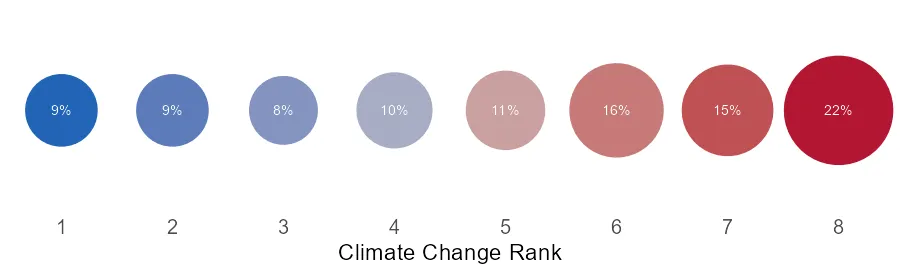
One way of measuring this is to ask people to rank a list of issues from most to least important. This was the purpose of my 2022 survey of New Zealand and Australian voters which asked respondents to rank climate change relative to seven other issues: health, education, crime, immigration, the economy, terrorism and poverty.
At the time, climate ranked most important with 9% of respondents, and least important with 22%. Overall, 36% placed it in their top four most important issues, but 64% had it in the bottom four (Figure 1 below).
Data source: Crawley (2022)
The New Zealand Election Study - a survey run after every election to understand what voters were thinking - asks an open-ended question about people’s most important issue.
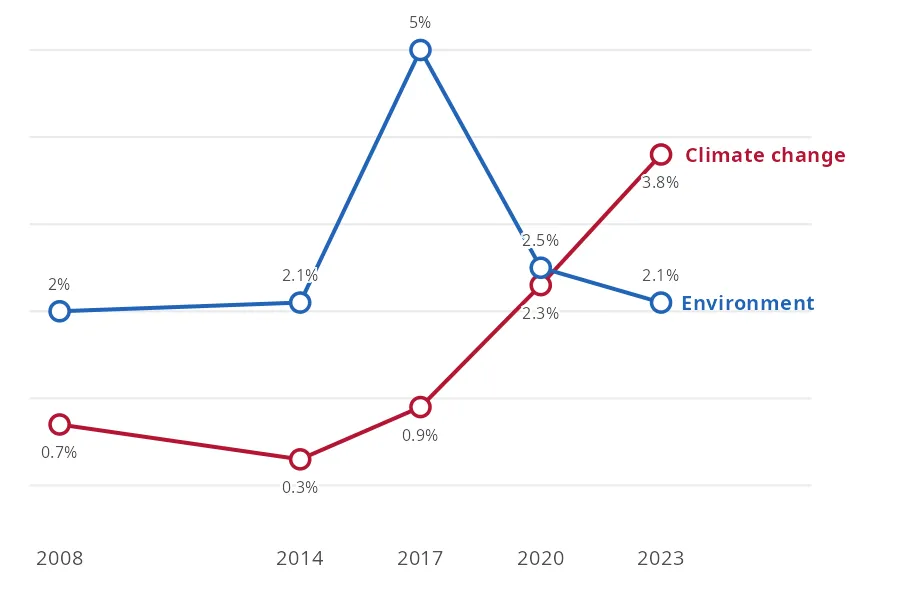
After the 2023 election, 4% said climate change was their most important issue, up from 2% in 2020. In contrast, the economy was the most important issue for 16% of respondents, and the cost of living for 15%.
More recently, we can refer to data from global polling company IPSOS, which regularly publishes an issues monitor report for NZ. In February 2026, even after the deadly summer weather disasters, climate change was only the eighth most important issue.1
Trends over time
Is climate change becoming more important to the public over time, and does that importance change in response to weather events? These questions are hard to answer and require frequent surveys over long periods.
We can go back a few years with New Zealand Election Study data, which shows mentions of climate change by respondents as their most important issue increasing over time, partly offset by declining mentions of the environment (see Figure 2 below).
Data source: NZES (2023)
IPSOS also measures longer-term trends. Climate change peaked as most important issue with 27% of people after Cyclone Gabrielle in February 2023. That declined to 19% just before that year’s election in October. It has hovered around 15% ever since.
This kind of response to extreme weather - where the importance of climate change fades not long after the event - has been widely studied. There is a clear pattern showing people’s concern levels spike when weather catastrophes hit, but return to base levels within a few months.
What this means in 2026
From what we know of public opinion patterns, there’s no reason to think 2026 will be a climate election in New Zealand.
A relatively small section of the public cares very deeply about climate change, and will tend to vote for the Green Party (which partly explains its relatively consistent support over time).
And the number of people who cast their vote with climate change in mind seems to be growing - but slowly.
There is undoubtedly enough public concern about the climate that we’ll hear about it during the election campaign, in debates and in party manifestos. But as a pivotal issue it is likely to be eclipsed by the cost of living and healthcare.
Perhaps if a weather event on the scale of Cyclone Gabrielle hits a month or two out from the election, things will be different (not that anyone wishes for that).
But the reality is, most New Zealand voters are not thinking about climate change when they enter the voting booth.
Footnotes
-
All three of these sources (my survey, NZES and IPSOS) use different survey questions to measure the most important issue. The results are therefore not strictly comparable. ↩
The analysis code for this post is available on Codeberg.
View code on Codeberg →