Climate polarisation in New Zealand: a growing left-right divide
Over the past 20 years, Kiwis’ belief in climate change has strengthened and preferences for government action have increased along with it. But there are now signs support for climate policies may be weakening.
My analysis of data on climate attitudes, taken from the 2020 and 2023 New Zealand Election Study (NZES) — which surveys the public after each election — shows the gap between left and right is widening and opinion is becoming more polarised.
Support for stronger climate policy
When it came to power in 2017, Jacinda Ardern’s Labour-led government made climate change central to its policy platform. During its first term, the government passed the Zero Carbon Act and ended the provision of offshore oil and gas exploration permits.
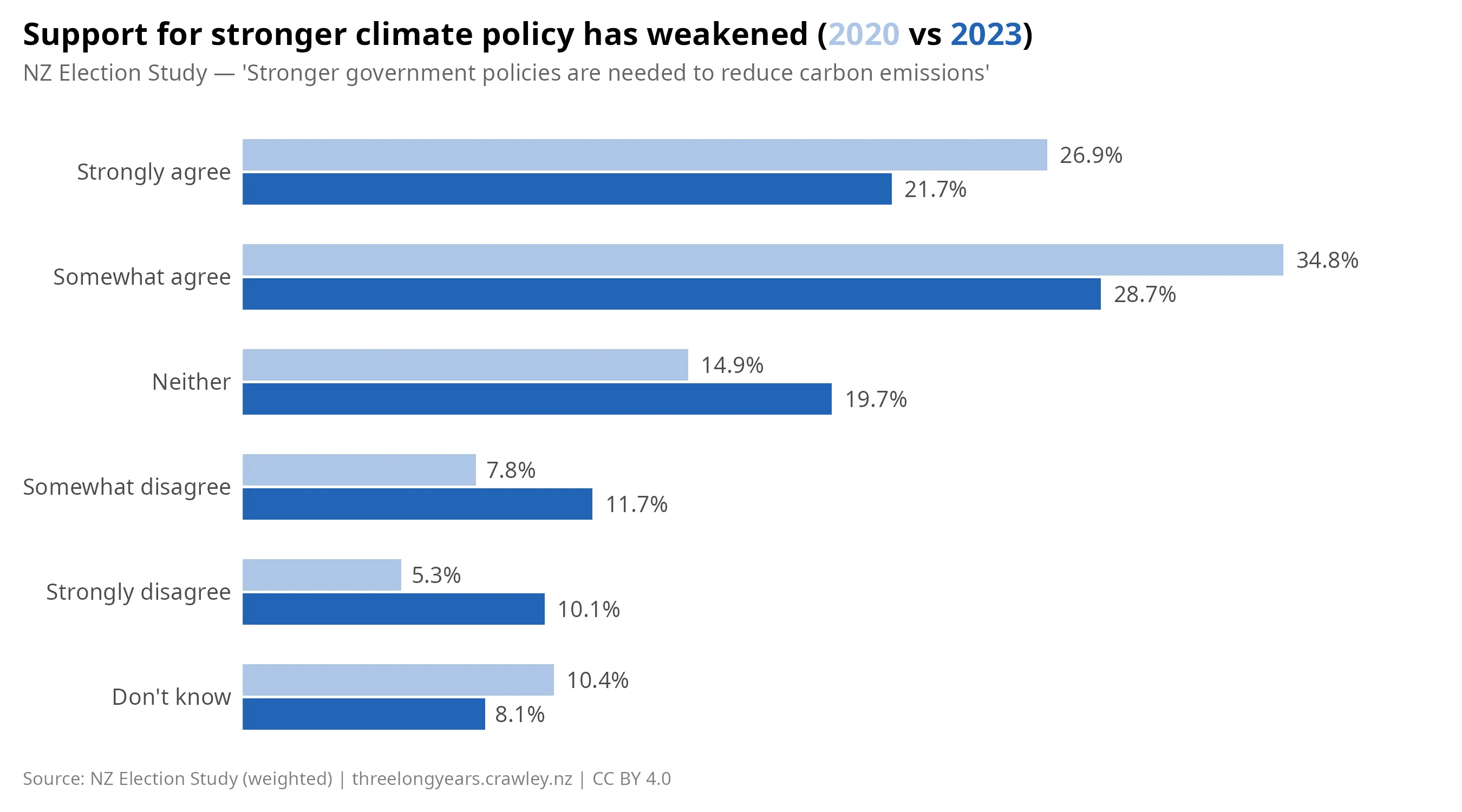
Against this backdrop, the 2020 NZES showed more than 60% of respondents agreed with the statement, “To act against climate change, stronger government policies are needed to reduce carbon emissions”.
But three years later, after the failure of the “He Waka Eke Noa” programme — a government-farming sector partnership to price agricultural emissions — and a backlash against climate policies from the rural protest group Groundswell, support had waned.
By 2023, just 50.4% wanted stronger climate policies. The proportion strongly disagreeing that these policies were needed doubled, from 5% in 2020 to 10% in 2023.
An overall drop of more than 10 points is notable. But it conceals a much sharper shift that becomes visible when we break down the numbers by left–right position.
The left-right divide on climate policy
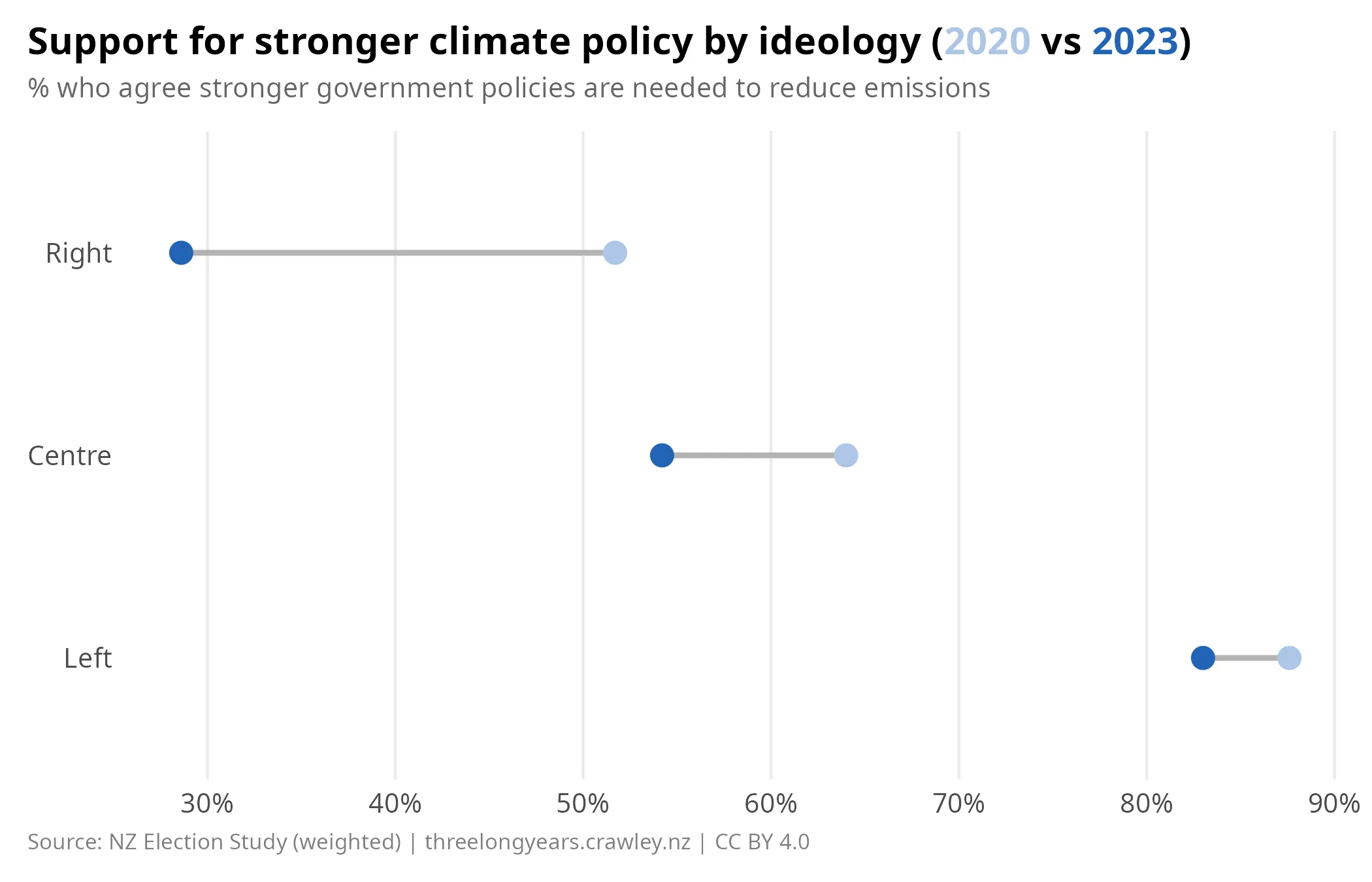
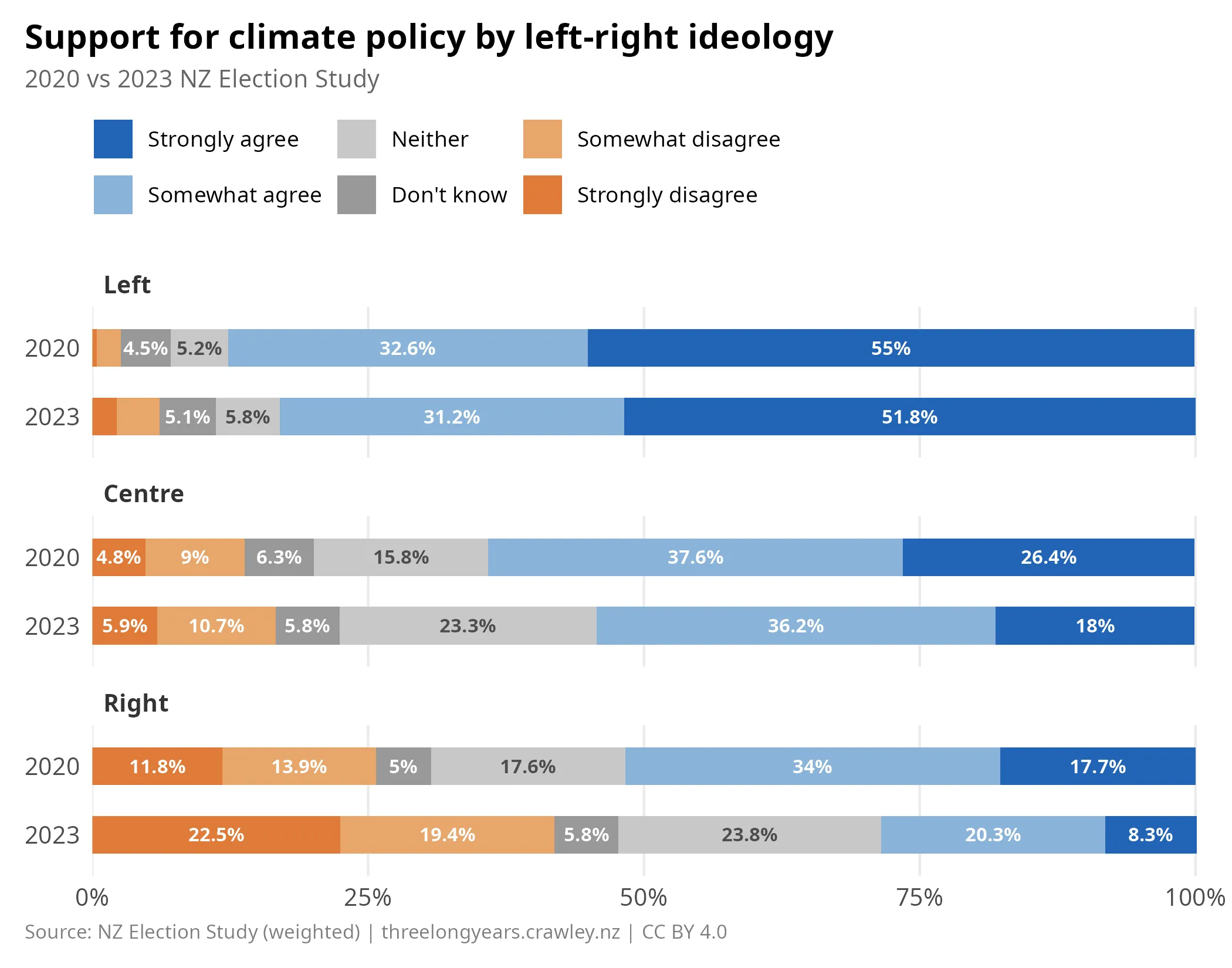
Between 2020 and 2023, there was a big shift in climate opinion among people who considered themselves right-leaning.1 In 2020, a majority of those on the right supported stronger climate action. By 2023, this had dropped to below 30%.
Support for climate policies declined among centrist and left-leaning voters as well, but by much smaller margins. Overall, the gap between left and right in support for climate action widened substantially.2
Full response breakdown of policy support by position
Policy support by party vote
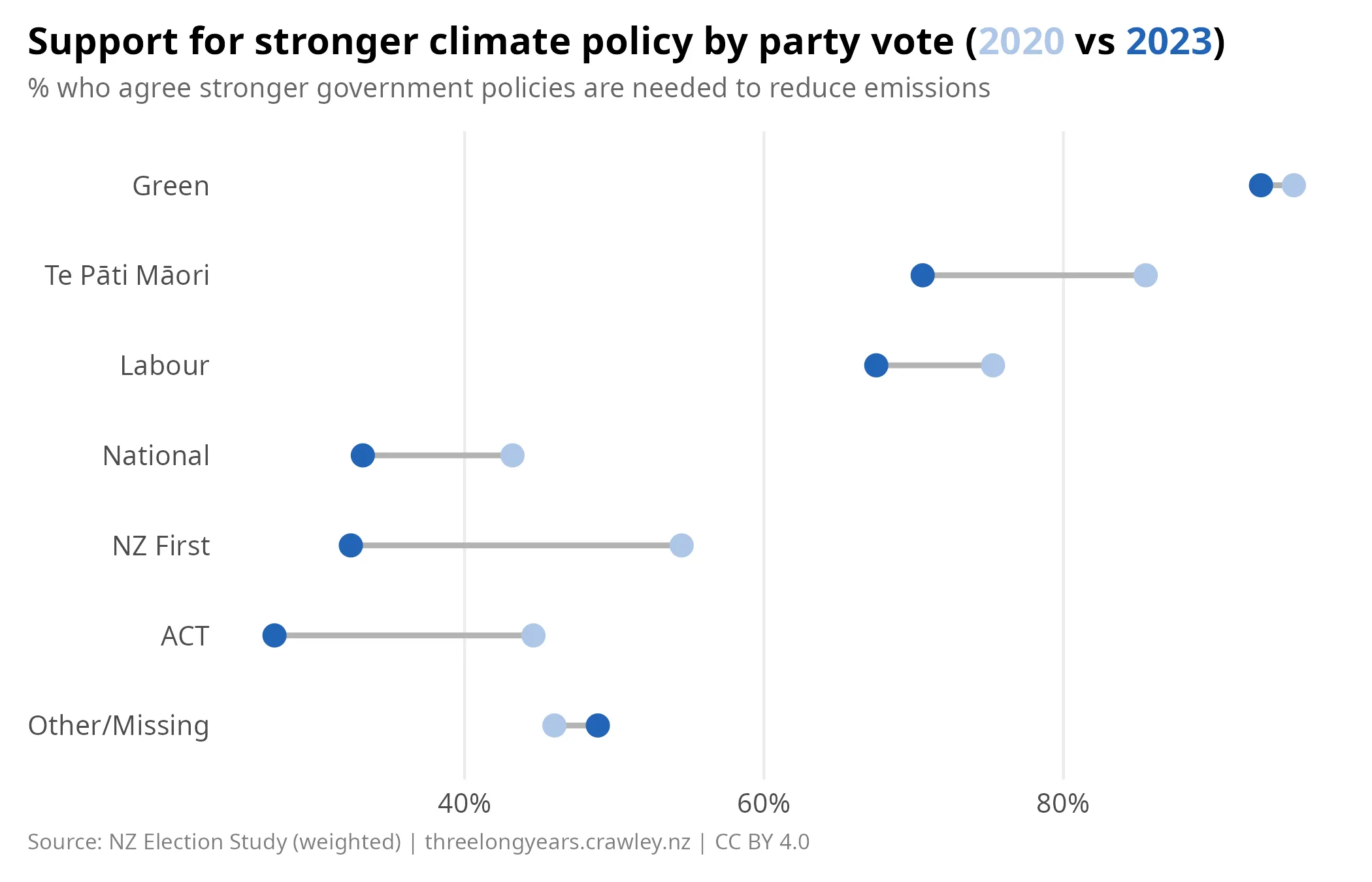
A gap in policy support — or beliefs in the science itself?
One reason support for stronger policy might decline is that people feel the government is already doing enough. The Labour-led government enacted several climate policies over its two terms, which could partly explain the drop in policy support in 2023.
However, we might expect people’s views on the science of climate change to be more stable than their level of policy support.
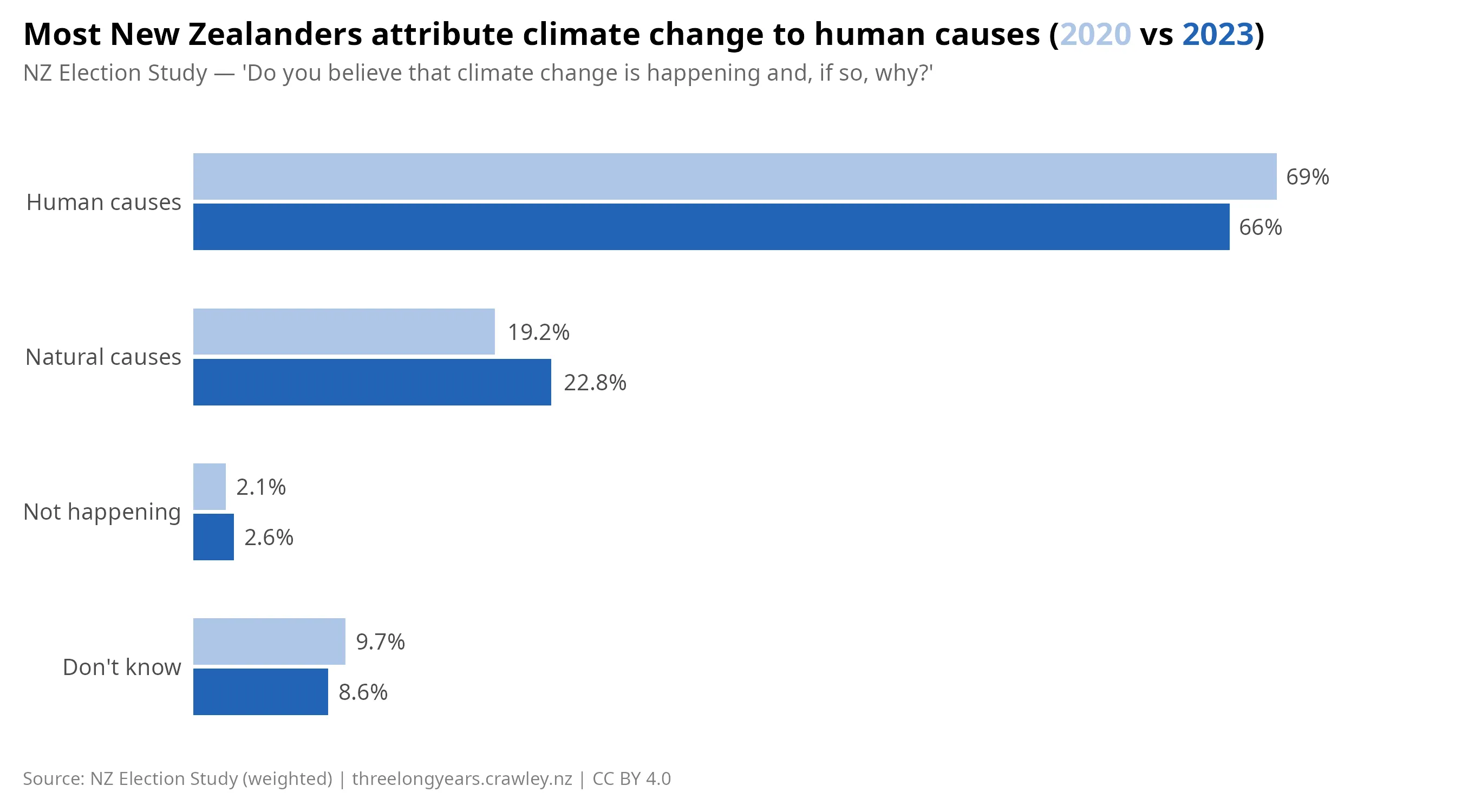
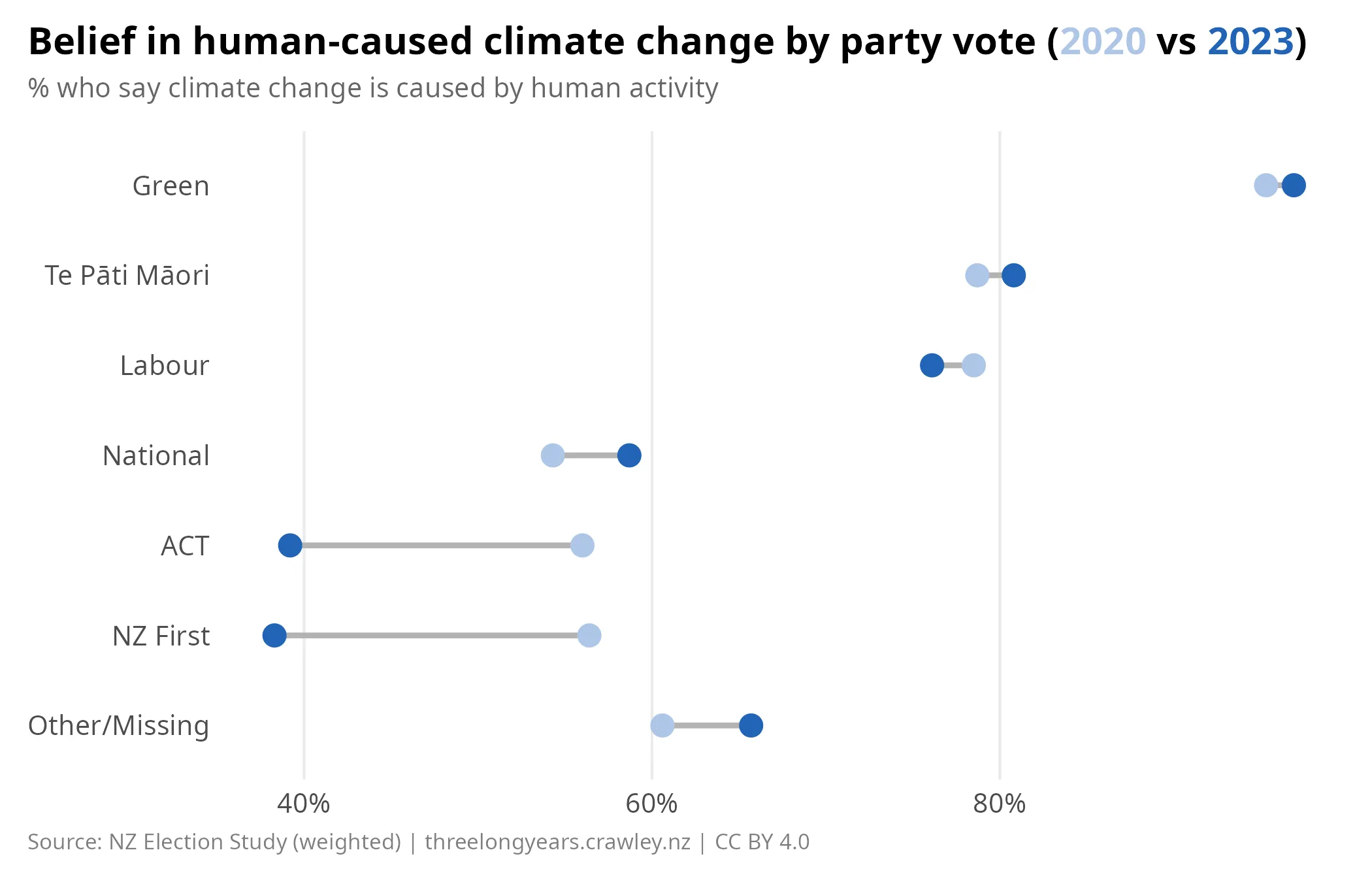
In 2020 and 2023, the NZES asked people whether they thought climate change was happening, and if so, whether it was caused mostly by human or natural causes. As we can see in the figure below, there was a small difference in responses between the two surveys, with fewer people in 2023 believing climate change was mostly attributable to human causes than in 2020.
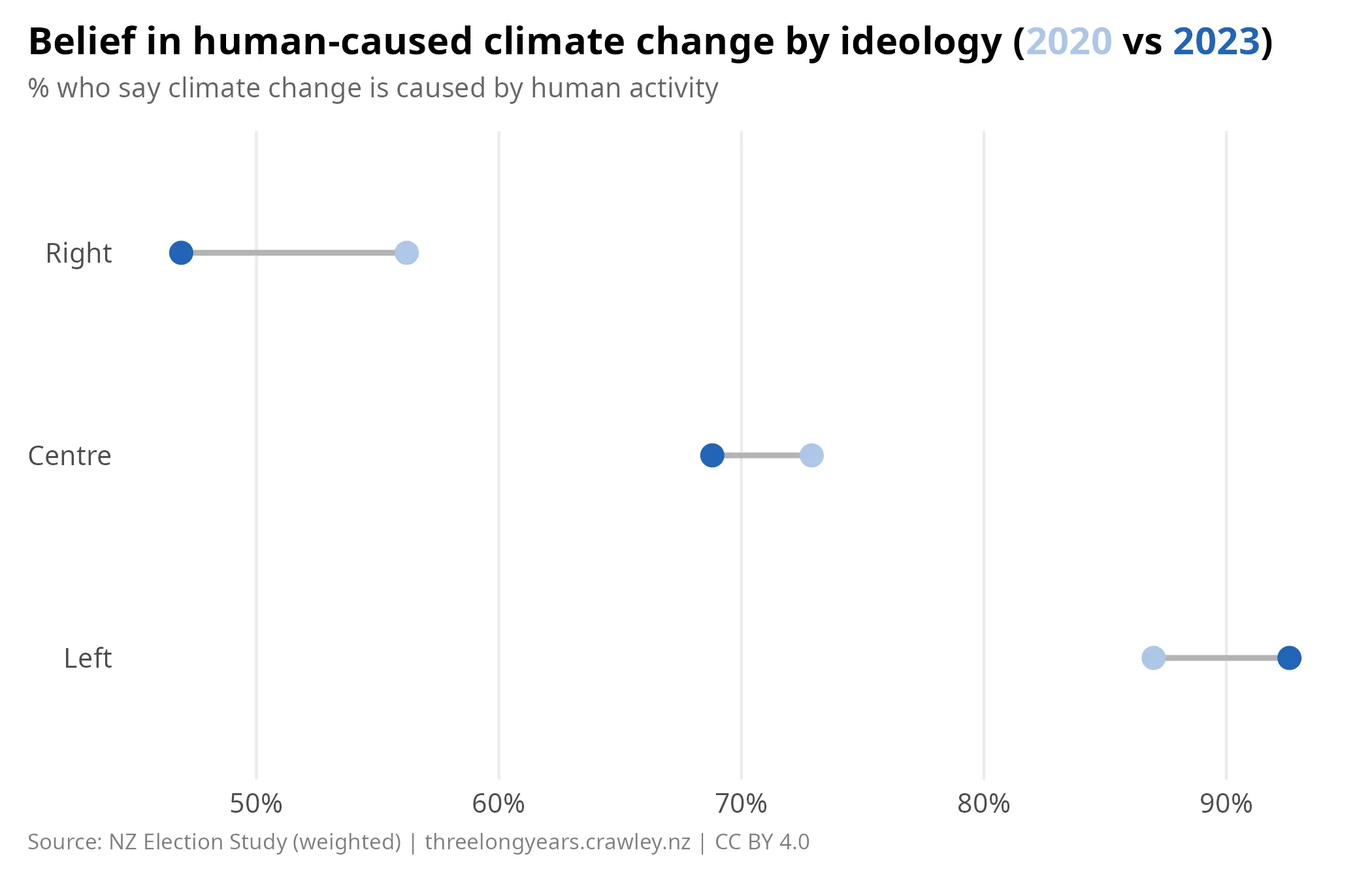
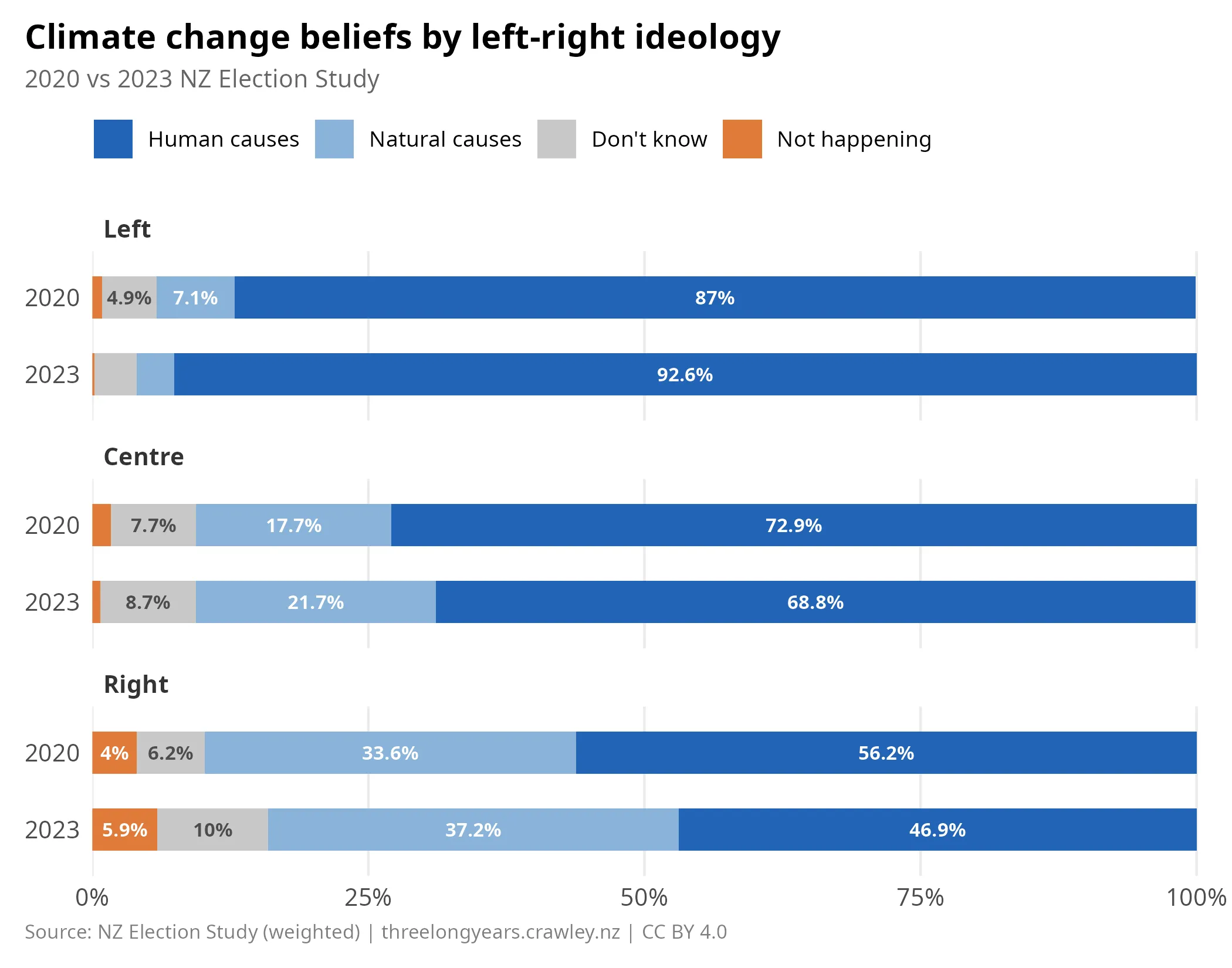
When we split responses by left–right position, we again find evidence of polarisation. Right-leaning respondents who attributed climate change mostly to human causes dropped by almost 10 points. The gap between left and right in 2023 stands at 46 points (93% vs 47%), up from 31 points in 2020 (87% vs 56%).
The picture of climate opinion in Aotearoa is of a gap between left and right that is not only wide, but widening.3
Full response breakdown of belief by position
Belief in human-caused climate change by party vote
Temporary blip or trend reversal?
My analysis is limited to the NZES results for 2020 and 2023. This is because the same climate questions were not asked in earlier NZES surveys. It’s entirely possible that 2023 was a low point for climate concern and we might see a turnaround.
There are reasons to believe, however, that we may be seeing the beginning of a trend reversal of climate concern among the public. World and national events — including the Iran war, the fuel crisis, and growing economic anxiety — can leave less space for climate concerns. Climate change, which can feel less immediate than the cost of living, might just drop down our priority lists.
Climate change has also become entangled in the culture wars across the Western world, as have issues such as immigration, LGBTQI+ rights, and gender equality. These cultural issues have been on the front line of politics and are a major contributor to political polarisation.
There are similar patterns emerging in climate views in many countries — such as Germany, where the gap in climate opinion is widening along ideological lines and is linked to support for the radical right party AfD.
The widening left–right gap in climate opinion we’re seeing in Aotearoa therefore seems to be part of a global trend. We may well have passed the high-water mark of public support for climate action in 2020 — but we’ll have to wait for the results of the 2026 NZES to confirm whether this is the case.
Unfortunately, if we are witnessing a long-term decline in support for climate action, and a widening gap between left and right, it is only going to get harder to push effective climate policies across the line.
A version of this article also appeared on Newsroom.
Footnotes
-
These categories are based on a question asking people to position themselves on a scale between 0 and 10, where 0 is the “left” and 10 is the “right” of politics. I categorised people as left if they answered 0-3, centre for 4-6 and right for 7-10. ↩
-
See the additional figures for the full response breakdown, and policy support by party. ↩
-
See the additional figures for the full response breakdown, and climate belief by party. ↩
The analysis code for this post is available on Codeberg.
View code on Codeberg →