Is New Zealand's democracy in decline? What expert assessments tell us

Viktor Orbán’s defeat in the recent Hungarian election was a victory for democracy. But the result bucks the trend of the last 20 years: democracy around the world is in decline. The US, in particular, has seen a significant decline in quality of democracy over the last decade. Where does New Zealand fit into this picture?
Many Kiwis might assume that New Zealand is largely immune from democratic backsliding. MMP makes it harder for single parties to govern, meaning power is less centralised. Politicians generally exercise tolerance of their opponents, and political debates don’t often get over-heated. None of our parties fit the mould of the populist radical right that has driven democratic backsliding in countries like Hungary, Poland, and the United States.
That said, not everyone is convinced that democracy in Aotearoa is as healthy as it can be. Governments have increasingly used (and arguably abused) urgency powers to push through legislation with minimal debate — a trend that has accelerated under the current government. The Fast Track legislation has seen heavy criticism, because it puts substantial power in the hands of ministers, and potentially favours special interests.
So how does democracy rate in New Zealand, and how do we compare to the rest of the world? Are we part of the global decline in democracy, or are we one of the outliers? In this post, I use data from the latest release from the “Varieties of Democracy” (V-Dem) project to see how Aotearoa ranks.
Democracy around the world
Exactly what constitutes a “well-functioning democracy” is a matter of debate. Most people would agree on a few core elements: free and fair elections, civil liberties, the rule of law, and freedom of expression. The V-Dem project surveys experts around the world on these and other aspects of democracy. One of V-Dem’s main indices is the Liberal Democracy Index, which combines indicators of some of these aspects of democracy to create a measure of both electoral competition and limits on government power.
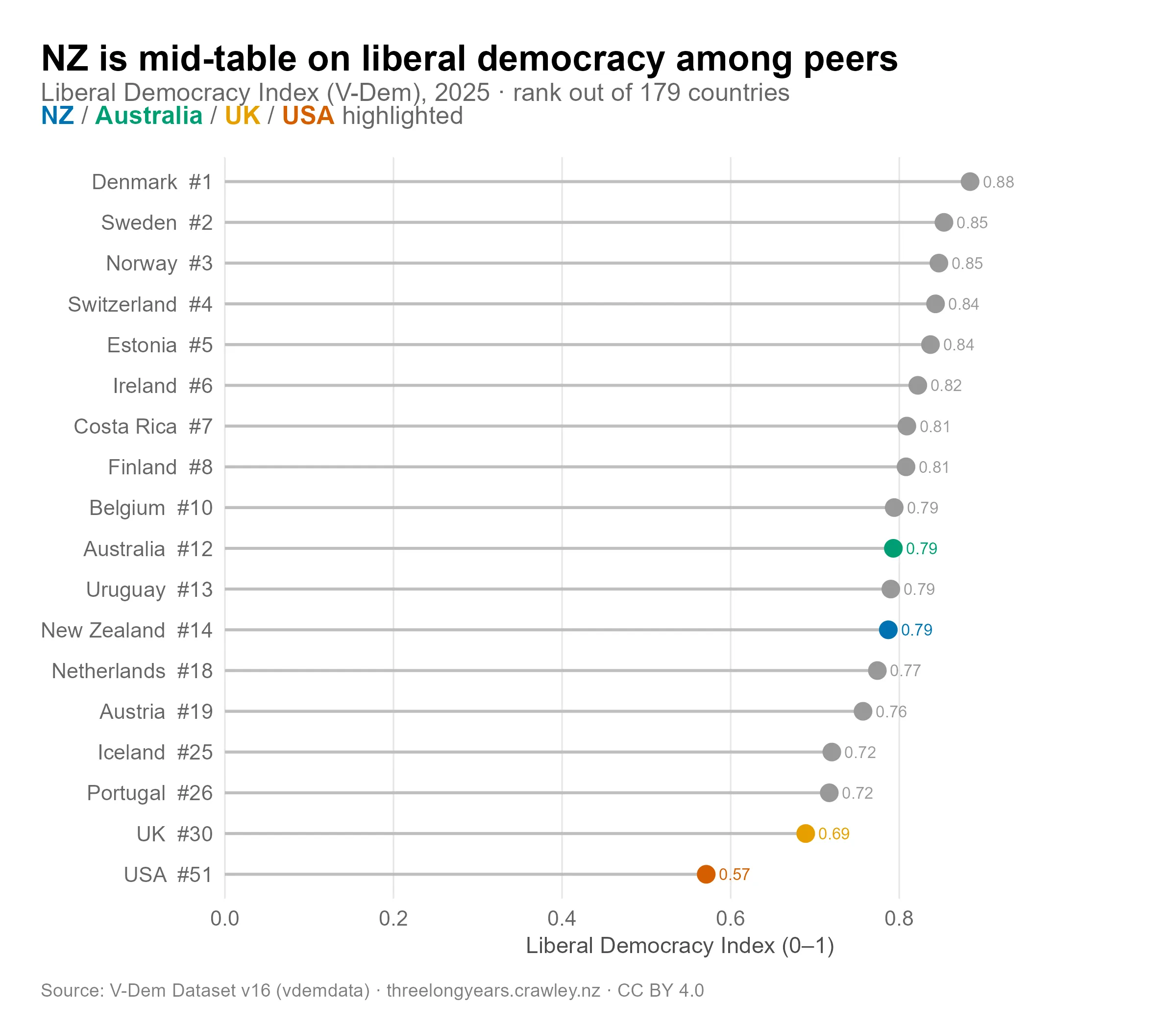
On this index, New Zealand looks in reasonable shape. We rank 14th overall, effectively level with Australia (12th) and well ahead of the UK and US. However, we trail the Scandinavian countries by quite a bit, as well as other states in Europe and beyond.
But headline rankings don’t tell the whole story. V-Dem also provides a “Deliberative Democracy” index, which focuses on the processes by which political decisions are made — and on this measure, New Zealand fares considerably worse. A country scoring high in Deliberative Democracy will have political leaders who consult widely across political parties and key social groups when making decisions, clearly explain their reasoning, and justify decisions in terms of the “common good” rather than benefits to specific groups.
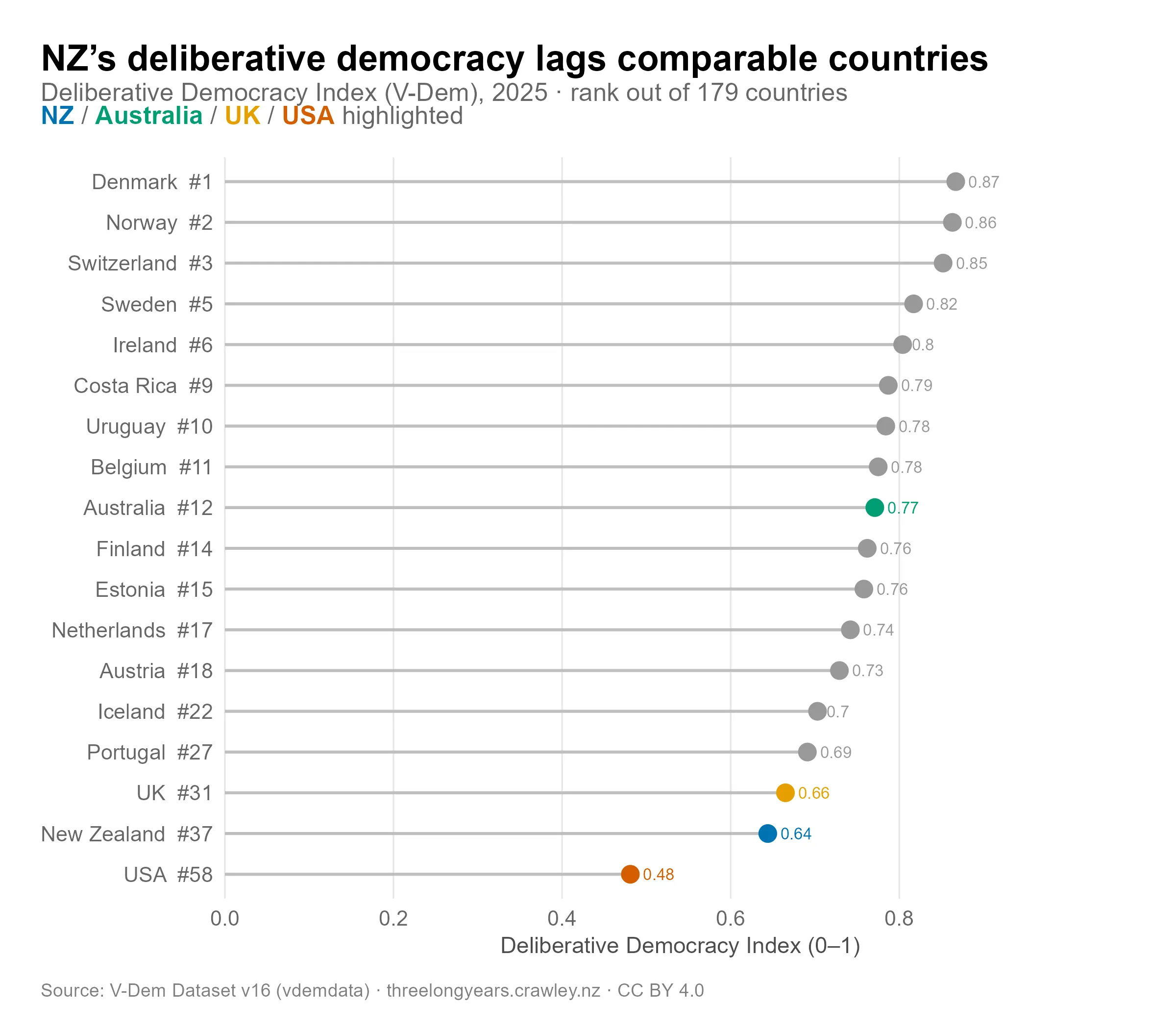
New Zealand still scores reasonably well in deliberation (ranked 37th out of 179 countries), but we are rated well below other comparable countries, such as Australia, and even slightly below the UK.
Political decisions in New Zealand therefore do not seem to involve as much consultation and deliberation as some other well-functioning democracies. Is this a long-term state of affairs, or a recent change?
Declining deliberation
V-Dem provides time series data going back many decades, allowing us to monitor changes in democracy over time.
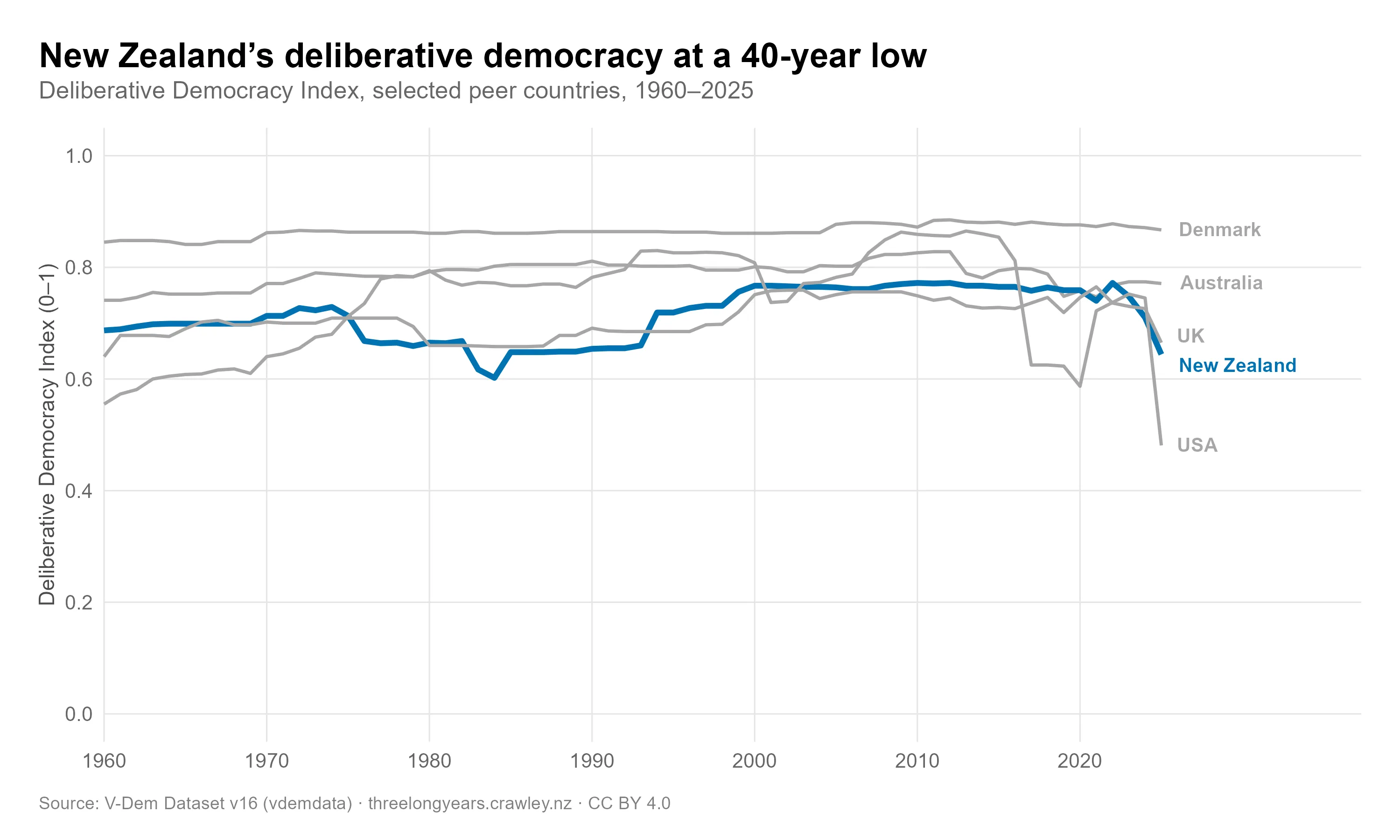
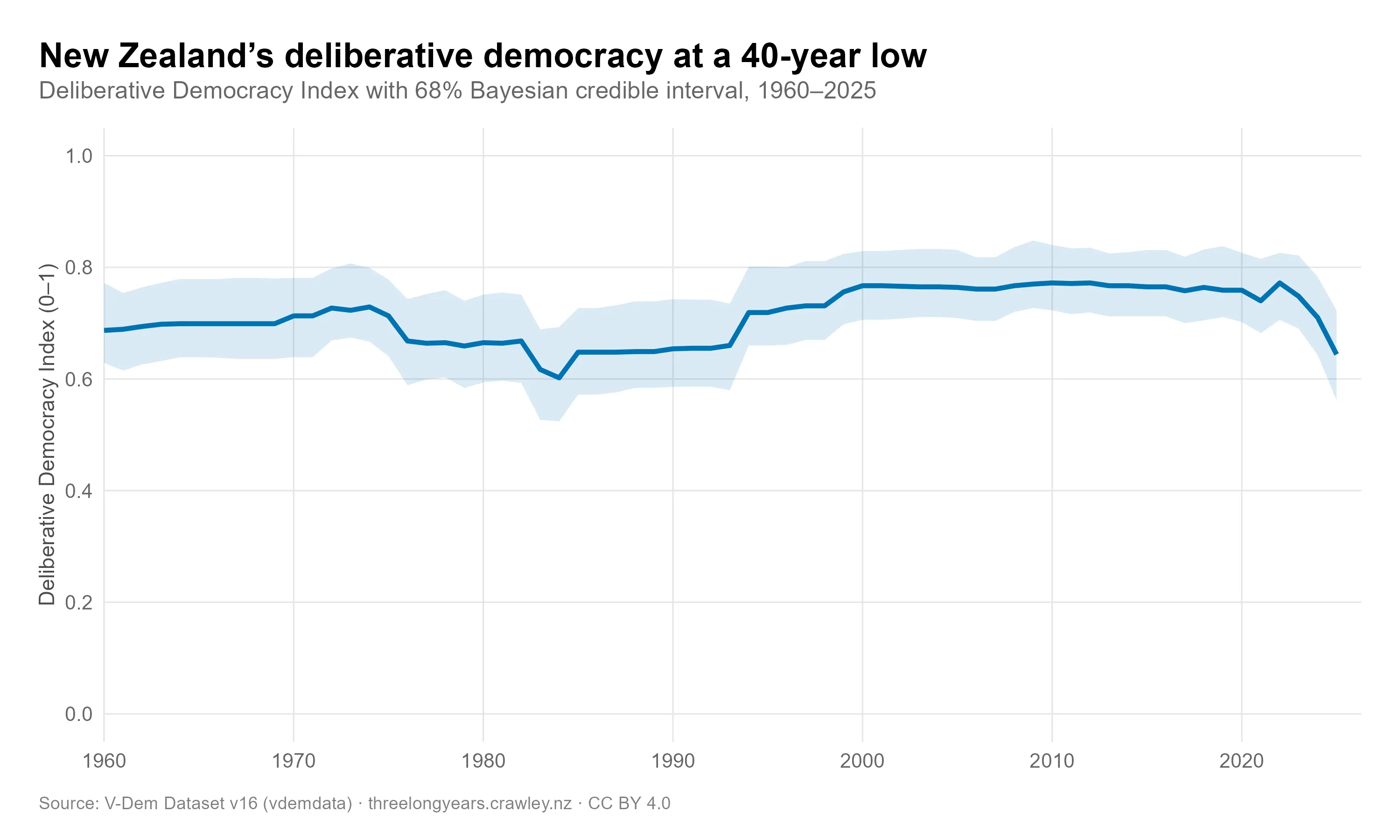
As we can see in the figure below, deliberative democracy in New Zealand is at its lowest point since the 1980s (during the Labour government’s neoliberal “revolution”).1 After two decades of relative stability, NZ’s deliberative democracy score has been declining. Scores dipped slightly under the previous government in 2021, recovered to a peak of 0.77 in 2022, then dipped again in 2023. The rating then fell sharply under the current coalition to 0.64 in 2025. It’s a steep fall, although not as steep as the decline seen in the US.
Deliberative Democracy Index for NZ (with confidence intervals), 1960–2025
Liberal Democracy Index, 1960–2025
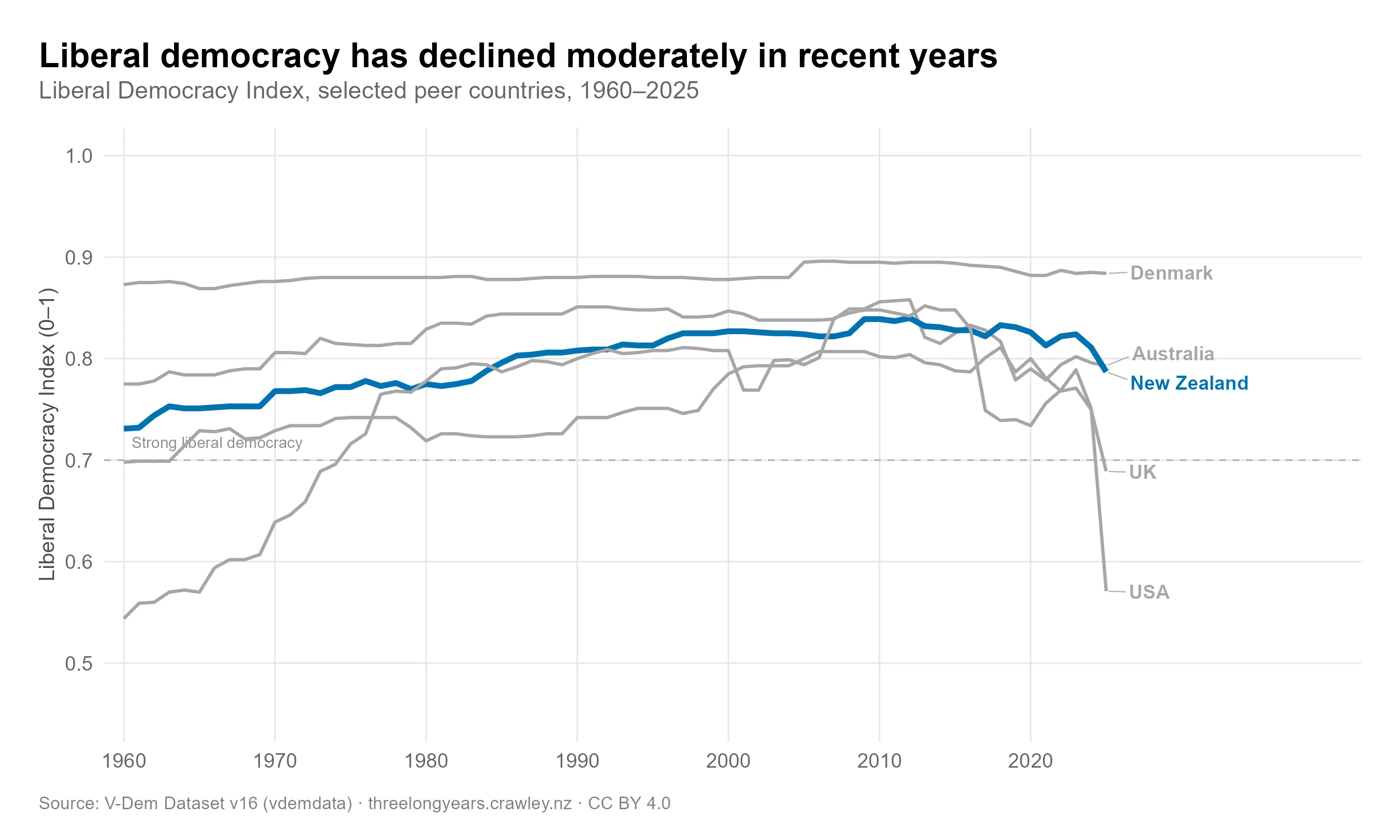
It’s clear, then, that the decline in deliberative democracy is recent, happening almost entirely during the current parliamentary term. The deliberative democracy concept is fairly abstract, though. What does this change mean in more concrete terms?
What is happening to deliberation in New Zealand?
We can get more detail on why the deliberative score is falling by looking at the individual V-Dem measures that make up the overall index. The decline is coming from lower scores in “consultation” (probably linked to the current government’s increased use of urgency), “common good justification”, and “respect for counter-arguments” — all of which have fallen since 2023.
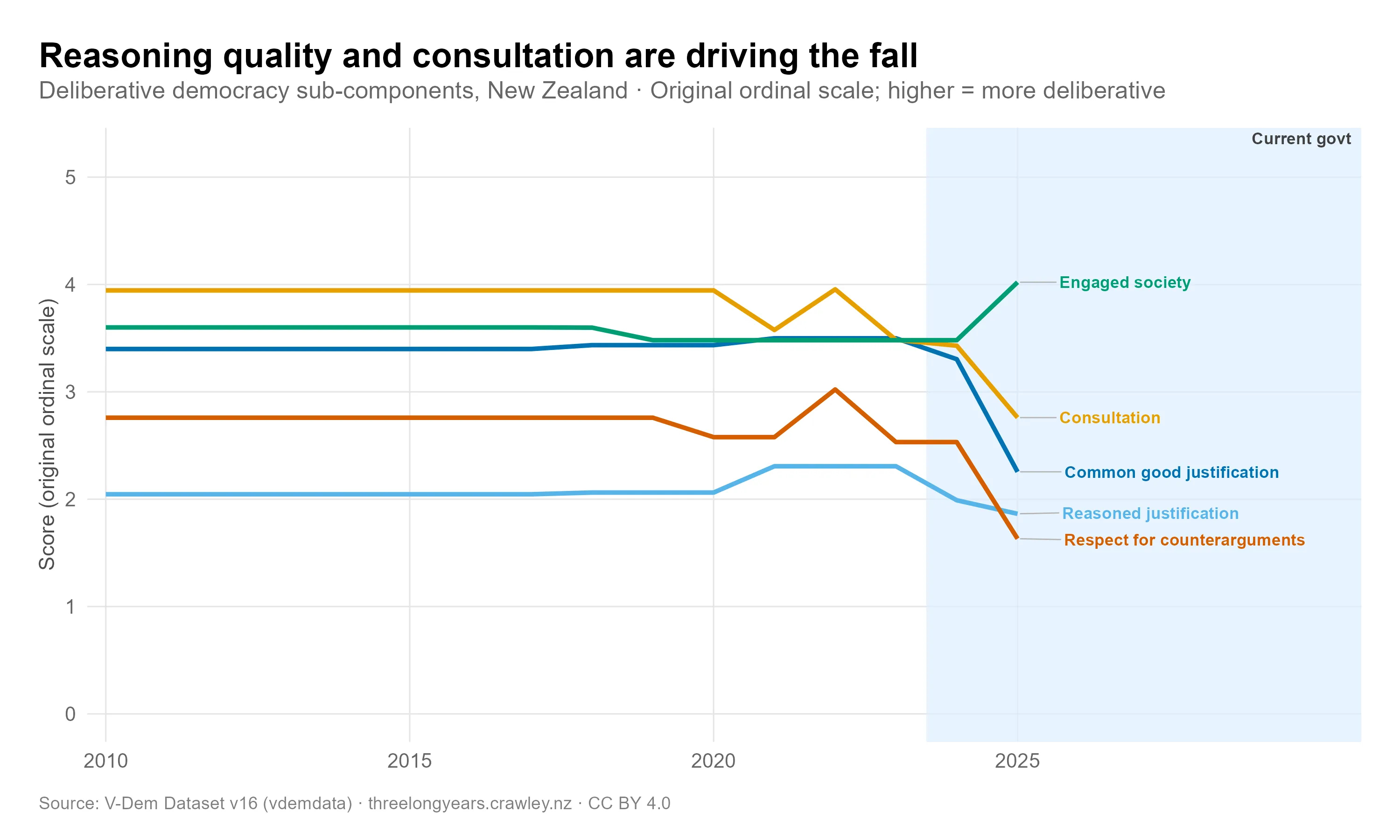
Interestingly, the score for “Engaged society” has increased recently. This rise likely reflects elevated civil society mobilisation around controversial legislation like the Treaty Principles bill.
These numbers suggest that the way the current government makes and explains its decisions is different compared to at least the two previous governments. It seems to operate more like governments of the first-past-the-post era, where decisions were primarily made “top-down”.
Conclusion
According to V-Dem’s assessment, there are clear signs of at least moderate democratic decline in New Zealand. The Deliberative Democracy Index shows the sharpest fall, but three of the other main V-Dem indices have also declined since 2022.2 The current government consults less widely and considers a narrower range of viewpoints than has been the NZ norm — a trend that began modestly under the previous government but has accelerated sharply since 2023. The use of urgency powers and legislation like Fast Track and the Treaty Principles bill are likely contributors.
It’s important to keep these changes in perspective, however. NZ has not seen rapid democratic backsliding as is the case in the US, and as was the case in Hungary until the defeat of Orbán.3
There are also limitations of “expert surveys” like V-Dem to keep in mind. Experts can make mistakes, and are not immune from biases (including recency bias). What the public thinks about democracy, and how much they trust the system, also matters a lot. I’ll be covering public perceptions of democracy in a future post.
That said, although NZ is not seeing democratic decline on the scale of other countries, we do not seem to have completely avoided the global trend. For those of us who think democracy is worth defending, the coming years will require careful observation and vigilance.
Footnotes
-
V-Dem also provides confidence intervals for its indices. I did not include them in this figure for clarity reasons, but I have provided a supplemental plot with the confidence intervals for NZ. The recent decline is outside those confidence intervals, giving us more confidence it’s a “real” decline, and not just statistical noise. Note also that V-Dem data for the most recent year can see minor revisions in future releases as the measurement model is updated with new expert codings. This is unlikely to change the overall conclusion given the size of the drop and the CI evidence, however. ↩
-
There are three other main democracy indices provided by V-Dem. All three have declined slightly since 2022, although none as sharply as the Deliberative Democracy Index. Between 2022 and 2025, egalitarian democracy went from 0.77 to 0.73, participatory democracy from 0.67 to 0.58 and electoral democracy from 0.88 to 0.85. Note, the “electoral democracy” index is a part of the other 4 main indices. ↩
-
It is very early days since the election in Hungary, and so difficult to say whether democracy will be fully restored. The signs are so far promising, however. ↩
The analysis code for this post is available on Codeberg.
View code on Codeberg →