NZ election issues: why the economy and cost of living aren't the same thing
Issues can define an election. There’s little doubt that 2020 was the COVID election. Despite the extreme weather we’ve seen this year, I don’t think there’s much chance of 2026 being a climate election.
Instead, the issues that dominate in 2026 will probably be the ones that were big in 2023: the economy, cost of living and healthcare. Recent polling shows these issues are at the top of many Kiwis’ priority lists. It’s unlikely this will change much by November.
Today, I want to show that while the top two issues — the economy and cost of living — are closely related, they are not the same. The received wisdom suggests the right “owns” the economy as an issue, but the data shows no one owns the cost of living, potentially leaving it up for grabs.
And as we’ll see, these two issues attract quite different voters.
The big issues of 2023
To understand the issues that might affect the 2026 outcome, we can look back to 2023 using NZES. The figure below shows the top responses to the question: “What was the single most important issue for you in the 2023 election?”1
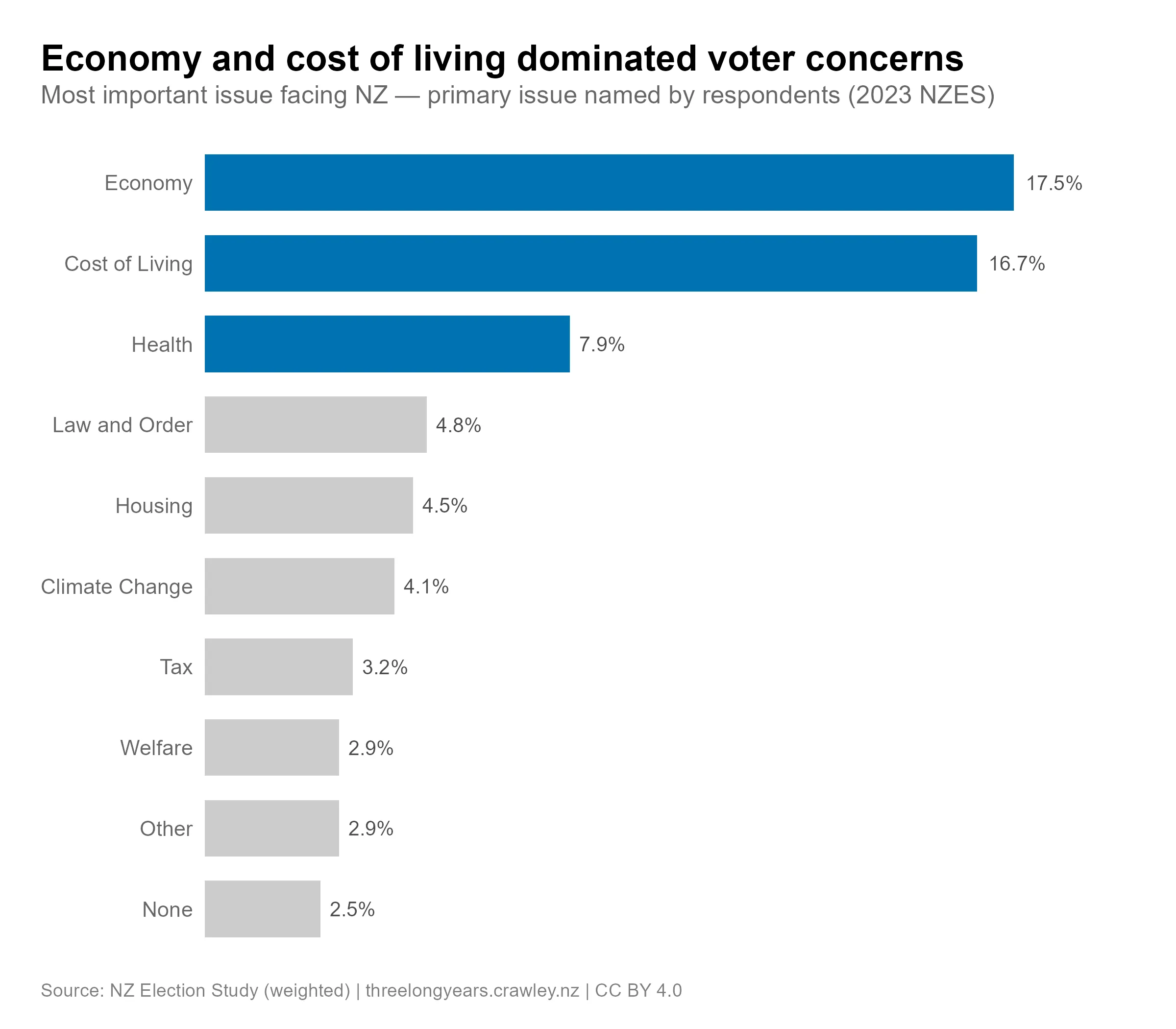
The economy and cost of living were clearly the two most mentioned issues, with health in third place. The economy is usually one of the top issues in any New Zealand election. Interestingly, though, cost of living barely featured in responses to this question in earlier NZES surveys, going back to 2008.2
The two terms imply different ideas — the economy is about how the country is doing as a whole, while cost of living is about what people experience directly. The difference matters; a government can point to GDP growth or low unemployment and claim the economy is doing well, while voters are still struggling with supermarket bills and rent.
But the distinction goes beyond framing — it also shows up in partisan preferences.
Which is the “best party” to address your issue?
NZES respondents were asked which party (if any) would be best at dealing with their most important issue. As shown in the figure, National was overwhelmingly viewed as the best placed to handle the economy (among people who said it was their most important issue). National clearly owned the economy as an issue in 2023.
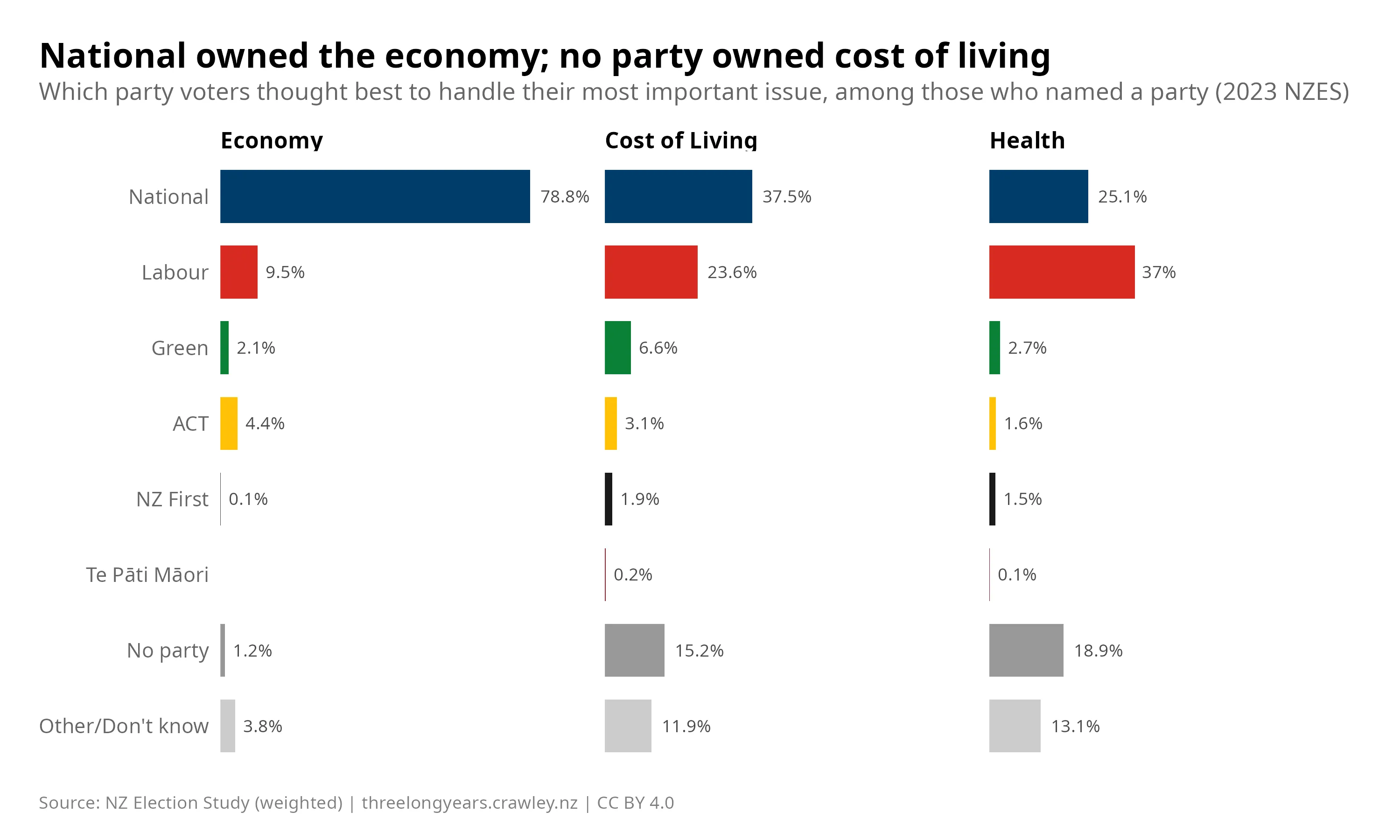
National was also the most mentioned party for people who said cost of living was their most important issue — but only 37.5% of people felt National was best placed to handle it. 23.6% of respondents felt Labour was best able to handle cost of living, while 15.2% thought no party could. Labour was the most mentioned party on health, although almost 19% felt none of the parties were able to address health.
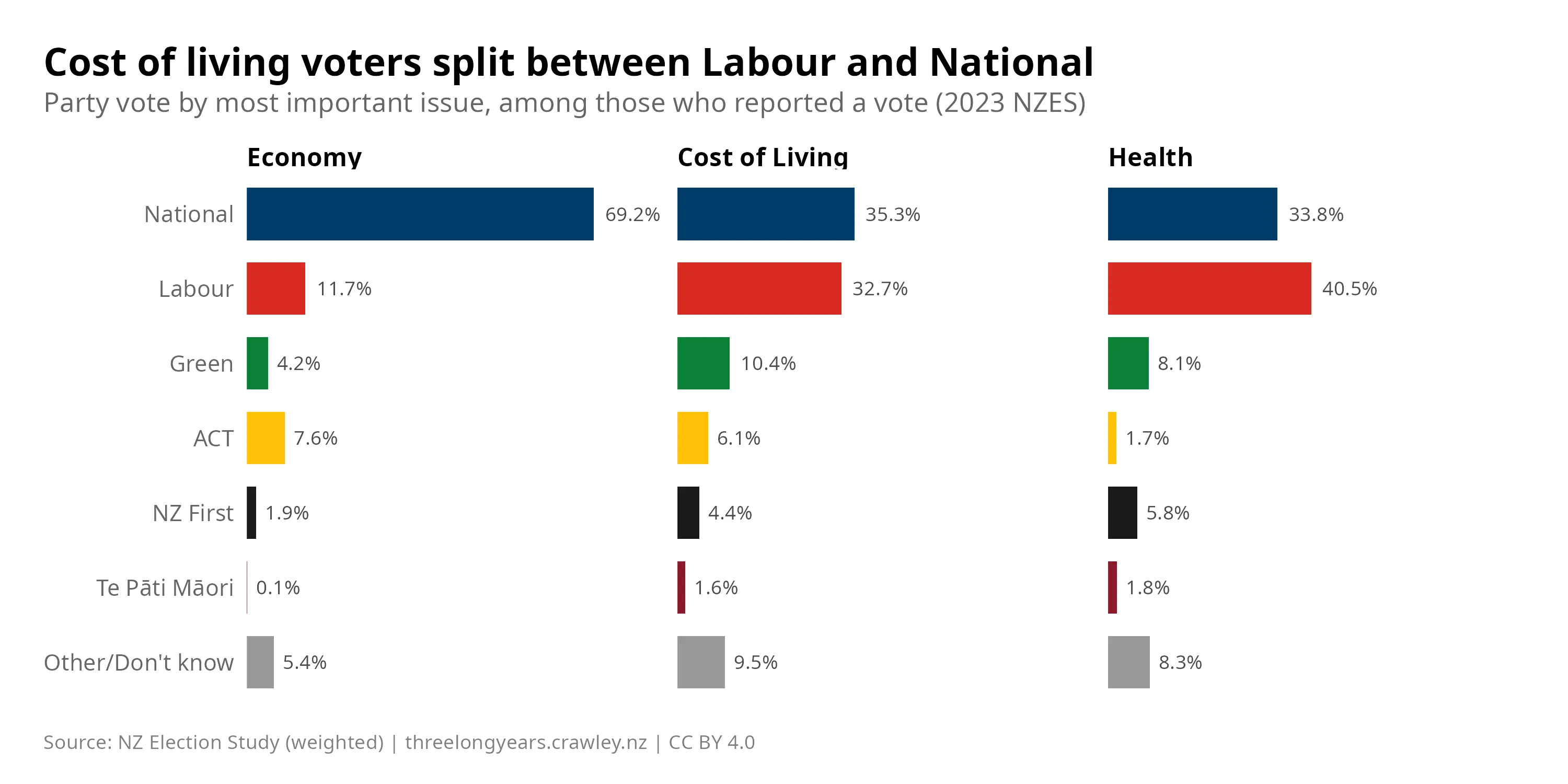
The supplementary figure below shows similar patterns when we look at the party people voted for, by their most important issue.
Party vote by most important issue
Issues and how voters feel about the parties
One limitation of the analysis above is that people could only select one “best” party. Some voters may have felt it was a close call between National and Labour.
We can also look at how much people like each party. NZES asked respondents to rate all the main parties from 0 (strongly dislike) to 10 (strongly like).
People who said the economy was their most important issue rated National 7 out of 10 on average, and Labour only 4. Labour had a small lead over National for cost of living (5.5 to 5.1), and a larger one for health (6.2 to 4.9). Cost of living and health are both issues Labour will probably feel they can contest again this year, since most people who rated those issues as important have favourable views of Labour.
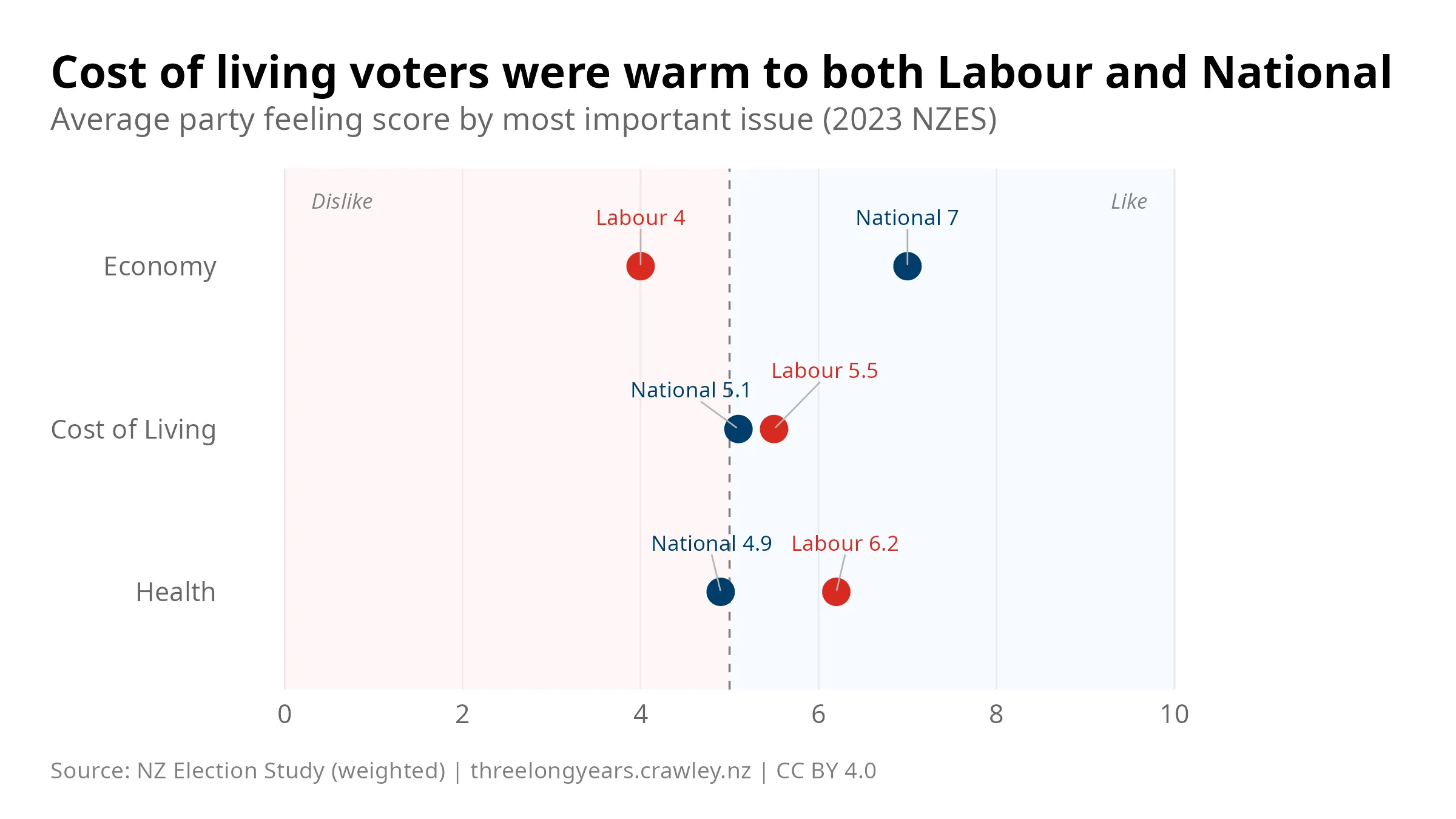
(Overall feeling averages — National: 5.1; Labour 5.1)
The pattern for the minor parties confirms that people who view the economy as the top issue tend to be right-leaning, with ACT scoring 5.3 in likeability, well above their overall average of 3.9. The Green party was seen favourably among people who viewed health as the most important issue.
Feeling scores for minor parties by most important issue
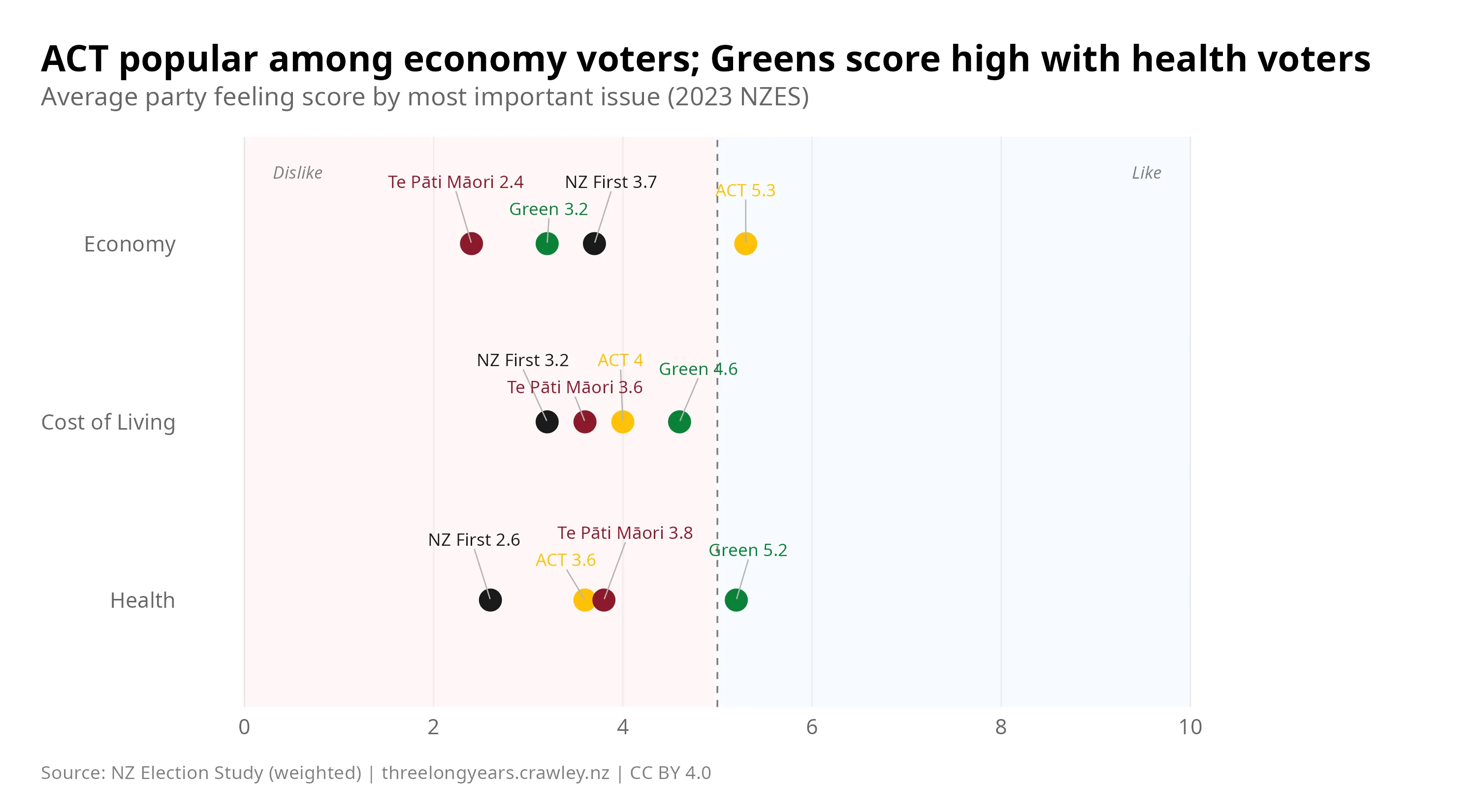
(Overall feeling averages — ACT: 3.9; Green: 4.5; NZ First: 3.3; Te Pāti Māori: 3.6)
What does this mean for 2026?
The top 3 issues in 2026 are likely to be the same as they were in 2023. However, February 2026 data from polling company Ipsos shows that people’s priority has changed. Cost of living is now the most important issue for Kiwis. Healthcare is second, and the economy has slipped to third.
The political context has also shifted. Labour was the incumbent in 2023, and inflation was spiking to multi-decade highs. It’s likely that a lot of voters held Labour accountable for their difficult personal economic circumstances leading up to that election.
In 2026 though, the roles are reversed. National is overseeing an economy that many people feel is not working for them, and the situation could continue to get worse due to the Iran war and the fuel crisis it has triggered. By November, the government may be able to point to improving economic indicators — or at least blame global headwinds for the ones that aren’t. But it may not matter much if people don’t feel any economic uplift in their daily lives.
Healthcare will probably remain a top concern, and the 2023 data suggests it’s an issue where Labour has an advantage — though not an uncontested one.
All this suggests that Labour is well positioned to win over cost of living and healthcare voters in 2026. The Ipsos issue monitor confirms that Labour is seen as best placed to manage cost of living, healthcare and most of the top issues people are worried about. Even the economy was seen as jointly owned by National and Labour.3
Of course, issues aren’t the only thing that shapes people’s vote — partisanship, leaders, and values all matter, and a lot can change before November. But the 2023 data tells us something important: no party owns the current top issue — the cost of living. That makes it a key battleground of 2026, and the party that shows it can actually make a difference to voters’ daily economic lives will have a strong claim to government.
Footnotes
-
The responses to this question are open-ended — respondents can write whatever they like in the text box. These responses were categorised using an LLM, via a verified coding process. ↩
-
I investigated the trends of most important problem responses going back to 2008 for an article currently under review in Political Science journal. ↩
-
The Ipsos survey differs from NZES in that it allows people to pick multiple important issues. Ipsos also asks all respondents who was best placed to handle an issue, not just those who saw it as their top issue. ↩
The analysis code for this post is available on Codeberg.
View code on Codeberg →