How partisan is Treaty of Waitangi opinion?

In the current parliamentary term, te Tiriti o Waitangi / Treaty of Waitangi issues have been arguably more prominent than at any time since the mid-1970s. The coalition government’s focus on the Treaty has been driven, in large part, by the junior partners: NZ First and ACT.
National’s coalition agreement with ACT included a provision to support the controversial Treaty Principles Bill to a first reading in parliament. Opposition to this bill sparked the haka by Te Pāti Māori MPs on the floor of parliament, which went globally viral, and resulted in unprecedented suspensions for several politicians.
NZ First had Treaty policies of its own, agreed to by National in their coalition agreement. Specifically, NZ First wanted all legislation reviewed and references to “The Principles of the Treaty of Waitangi” replaced or removed. This review is underway, and expected to be completed later this year.
Today, my focus is on public perceptions of Treaty issues. Treaty issues seem to be increasingly contentious in parliament — is the same true among the public? Is there a clear left/right divide on the Treaty? And how will Treaty issues play out in 2026 and beyond?
Support for removing Treaty references from the law
When I first heard about the NZ First coalition provision to review Treaty references in legislation, I immediately thought of the New Zealand Election Study (NZES). Data on public support for specific policies in New Zealand is hard to come by. It’s even rarer to have a long-running time series on a particular policy topic.
Fortuanately, however, the NZES has asked people — since 1993 — how much they agree or disagree with the statement: “The Treaty of Waitangi should not be part of the law”.1 Although the wording does not line up perfectly with the government’s review, it is a pretty close fit.
Data source: NZES (1996-2023)
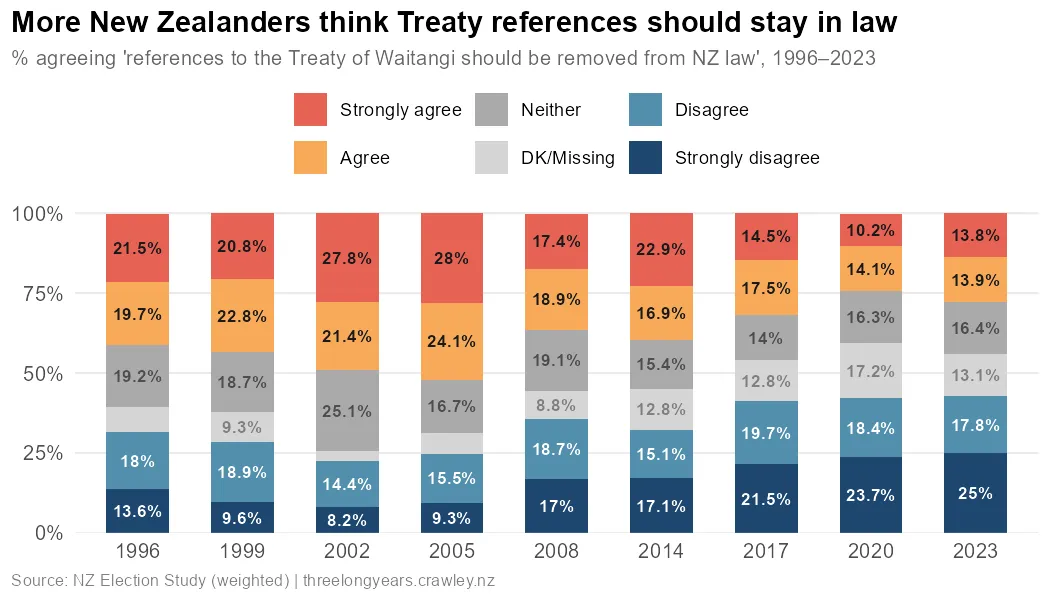
In figure 1, I show the overall results based on this question from 1996 onwards. The trend is towards greater acceptance of the Treaty in law. In 2005, a majority of New Zealanders did not want the Treaty to be part of the law. By 2023, this pattern had flipped, with 43% supporting keeping the Treaty in law.
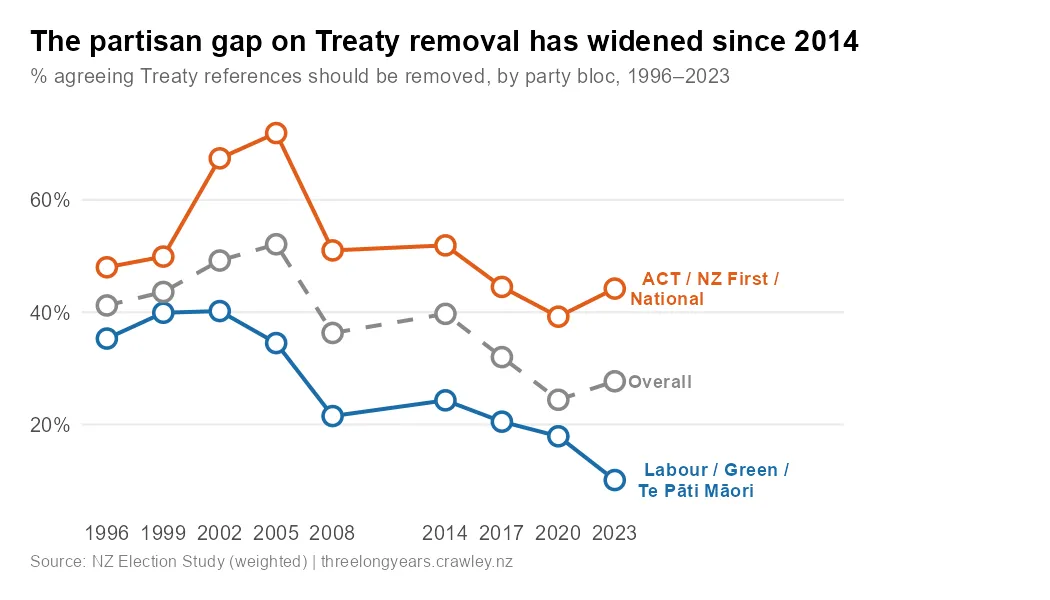
As we can see in the next figure, though, there is a clear split depending on which party people support.2 People who voted for the current coalition parties have substantially higher support for removing the Treaty from the law than those for the opposition parties. In 2023, the gap between left and right parties was the second widest of the period, with a net difference of 34 percentage points.
Data source: NZES (1996-2023)
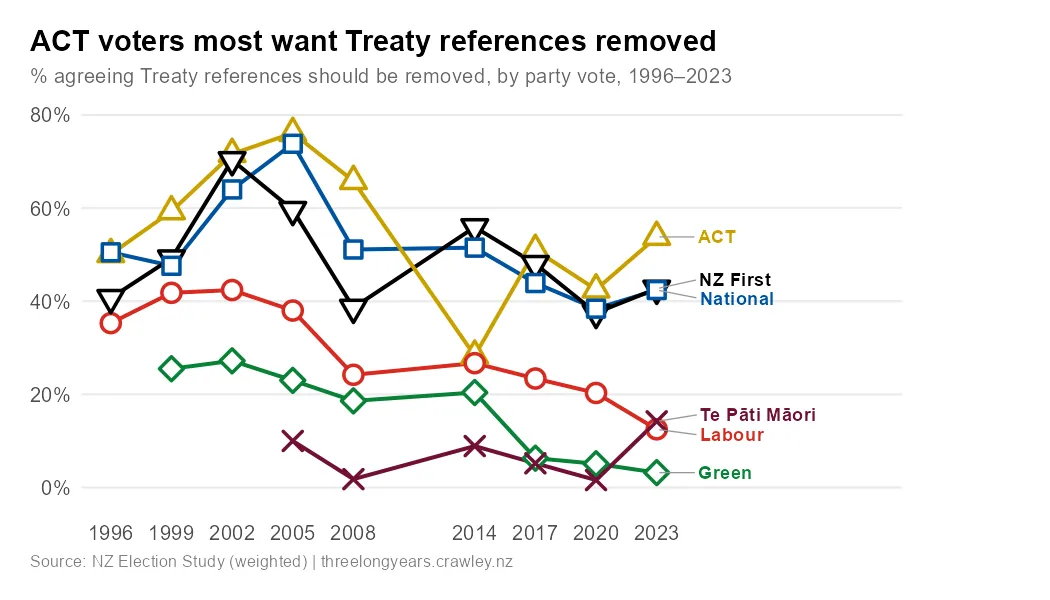
Should the Treaty be part of the law by individual party
Data source: NZES (1996-2023)
Have Treaty settlements gone too far?
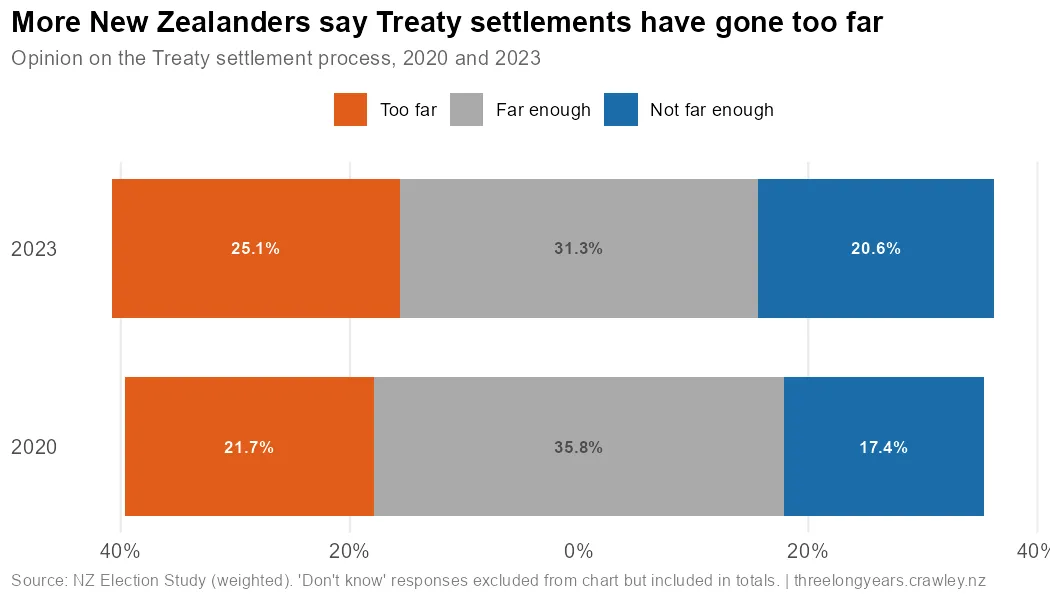
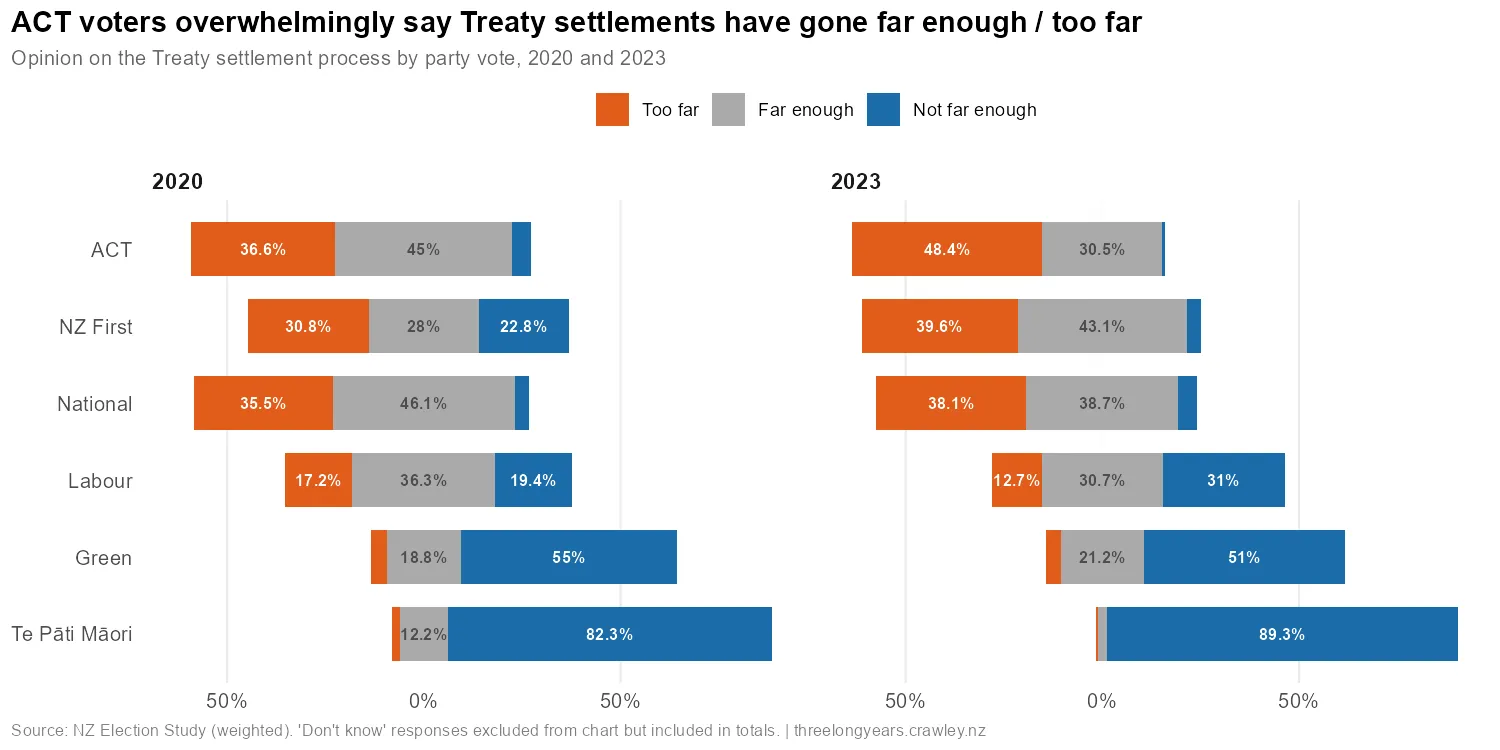
Whether the Treaty should be part of the law is arguably quite a technical question. Many people might struggle to answer, even if they have strong opinions on the Treaty. A second NZES question gets at the issue more directly. Included in the 2020 and 2023 NZES surveys, it asks people whether they think Treaty settlements have gone too far, far enough or not far enough.
Overall Treaty settlement opinion
Data source: NZES (2020, 2023)
Data source: NZES (2020, 2023)
Overall, New Zealand is fairly evenly split between believing settlements have gone too far vs not far enough (see additional figure). But, as shown in figure 3, there is a clear left/right divide on this topic, and that split seems to be growing over time. Very few National, ACT or NZ First supporters feel Treaty settlements should go further, while a majority of Green supporters and almost all Te Pāti Māori supporters do.
Interestingly, Labour supporters are quite evenly split on Treaty settlements, although the trend is towards more Labour voters believing settlements should go further. Still, this split could create headaches for Labour. Pushing too hard against the current government’s Treaty policies could risk alienating some of their supporters.
So, while overall support for the Treaty has grown, the partisan divide has widened.
The 2026 election and beyond
Given these partisan splits and the steady news coverage of Treaty policies, should we expect the Treaty to feature prominently in the 2026 campaign?
My expectation is that we will hear about Treaty issues more than in previous years.3 However — similar to climate change — Treaty issues are low salience. In 2023, Treaty and Māori issues were mentioned by only 2.4% of NZES survey respondents as the most important (a rise from 0.3% in 2020).4 Treaty issues are unlikely to turn the election.
But low salience doesn’t mean low stakes. The data above shows that coalition supporters feel strongly that Treaty settlements have gone far enough or too far. A re-elected coalition government is likely to continue pursuing similar Treaty policies — and have every incentive from their base to do so. These policies have received criticism from different directions, including the Waitangi Tribunal, as being harmful to Māori.
In other words, what happens this November could shape Aotearoa’s approach to the Treaty well beyond the next parliamentary term.
Footnotes
-
The only year this question was missed out was 2011. The wording was slightly different in 1993, so I’ve only included 1996 onwards (which also aligns with the MMP era). ↩
-
Party support is based on who the respondent said they cast their party vote for in the election that year. I’ve chosen to combine the parties by their current left/right blocs for this figure, although the political alliances have shifted over time. The “overall” line includes supporters of all parties, not just those shown in the figure. ↩
-
Treaty issues and issues affecting Māori are often debated and discussed in campaign spaces oriented around te ao Māori. These issues tend to receive much less attention in debates on the main media platforms, however. ↩
-
There was also a rise in concerns about “identity” or “fairness” issues (including anti-Treaty sentiment) in 2023. These issues were mentioned by 5% of people, up from 1% in 2020. ↩
The analysis code for this post is available on Codeberg.
View code on Codeberg →